
I really enjoyed the thesis presentations. The first presentation was very interesting and I liked how she incorporated parts of her own heritage and upbringing with literature that she was interested in to make a presentation about one of the common books in the literary canon. I liked how she added real-life elements such as the Bran Castle to show that what she was writing about was not entirely fiction. Something that stood out to me about her talk on the castle is if it should be a museum or a literary amusement park. The diction there was very striking and I would’ve never thought of that. The second presentation was my favorite and I loved the aspects of pedagogy that were implemented into her research. I took Intro to American Indian Literature last semester so I had some background knowledge on indigenous practices and values. Her point that we can’t teach with strictly Western ideas or Indigenous ideas made me think about the ways I would want to structure my own classroom. I liked that she showed the benefits of both thought processes and how it was better and more effective to combine them. I thought it was very smart how she added a character biography chart and used Mary Shelley’s Frankenstein as an example. That has been one of my favorite books since I read it a few years ago and her approach to it made me think. I liked how she used the indigenous values of appreciation for the natural world to connect it to the mountainous setting of Frankenstein and the ways in which it applies to the Romantic period of literature. The third presentation made me think about the use of religion in literature and the ways it is used to shape our moral standing. I thought it was very thought-provoking to see how in the grand scheme of things, goodness is usually measured by piety and the question of how will benevolence be measured in the absence of religion. It was intriguing to also ask, who does this goodness get judged by? He finished by asking us to pursue analytical relationships with simple pleasures. The last thesis presentation talked about wrestling culture in the world of sports literature. A lot of my friends from home were wrestlers so I had some understanding about the toxic aspects of the wrestling world and how the athletes are forced to torture their bodies for the sport. I think that the list of the five overarching values of wrestling was very interesting and creative. The way he counteracted his own claims with that was intriguing since his five beliefs were ones that are deemed as the social norms of wrestling. He ended his presentation by asking to question the morality of what should be accepted in wrestling literature and to show more diverse stories. Showing different stories allows for the voices of athletes who may not always win and who do not use horrific strategies to be accepted in wrestling. I liked the way he used his own personal experiences and stories to shape his presentation, and was personable while showing tough subjects such as weight-cutting. The overall theme of literature vs. social change was striking to me because it shows the way all four presentations tackled pressing social problems. I really enjoyed all of the thesis presentations and found every one of them to be thought-provoking.
Gurba Video Extra Credit
I really enjoyed watching the video of Myriam Gurba and it gave me an entirely new perspective of the book. I was a little surprised at first because I was not expecting her voice or way of speaking to be like that. I didn’t have any distinct preconceived opinions or thoughts, but it was not what I guessed it would be like. I really do enjoy that, and it is one of the reasons why I like listening to writers read aloud. It shows the way they view their work and how it is processed through their mind rather than the multitude of interpretations that readers can come up with on their own. I really like that she read the chapter from Mean of “Googolplex” because that was one of my personal favorites and the way she read it gave it a new passion and take. I also think that was a very relevant and significant chapter of her memoir. I liked how she read a new work that was not released yet, and seeing another one of her writings other than Mean was very nice to see because I enjoy her writing style. I find it significant that Gurba talks a lot about her childhood because it gives us insight into who she is currently as an adult as a result of what happened to her in her youth. Learning how she wrote her memoir was very interesting to me, especially hearing how it started as fragmented pieces that were not intended to be published at all. I can relate to what she said about reading works that you admire but can’t fully resonate with, thus making you want to create your own. I think that it is really important to have something that represents your story and if you can’t find one that does the job, making your own can be a great therapeutic method that can also inspire or heal other readers. I appreciate her thought processes about adding elements of horror, humor, and camp to talk about something deep and how the initial stages of her memoir are completely different than the model we read. It was interesting to hear that editing her manuscript took almost two years and she was not going to make it into a book when she first started writing. Hearing that some topics are still difficult to talk about even through the passage of time stood out for me because even though she can write about the trauma, it does not make the events any less challenging mentally to endure. It was also interesting to hear how she doesn’t like to be tapped on the shoulder or startled from behind because of the lasting trauma of her assault and the PTSD that came from it. Her saying that trauma is not an old mattress was a very intriguing metaphor. I never would’ve thought of it that way but I think it perfectly represents the ways that you can have new, pleasant experiences but the trauma and negative feelings from the event will still linger in the back of your mind forever. Overall, I think that this Zoom recording was an enlightening experience that helped me understand Mean and the thought process of Myriam Gurba much better. I enjoyed hearing her read her work aloud and give insight into her personal life, as well as the writing process of the memoir.
PTSD: An exploration of mental health in Mean as expressed through implications of sexual assault
Throughout this segment of Mean by Myriam Gurba, readers are brought into the narrator’s life more deeply through personal experiences that shape the way she sees the world. In this noteworthy portion of the book, we are introduced to the highly prevalent theme of mental health in regard to society and her sexual assault. Through Gurba’s retelling of her own rape encounter and the numerous ways it haunts her presently, we are able to see the persistent effects mental health can have on a person.
The harmful impacts of Post Traumatic Stress Disorder (PTSD) are implicated as Gurba explains the explicit and appalling details of her own rape. As per the fifth edition of the Diagnostic and Statistical Manual of Mental Disorders (DSM-5), PTSD is defined as “Intense or prolonged psychological distress at exposure to internal or external cues that symbolize or resemble an aspect of the traumatic event(s)”. It is apparent that Gurba is suffering from this, not only because straightforwardly she states so, but because of the gutwrenching side effects that continue long after her assault. She states, “Did you know PTSD is the only mental illness you can give someone? A person gave it to me. A man actually drove me crazy. He transmitted this condition” (Gurba 109). I find this quote very intriguing because her diction makes it seem as if mental disorders are something communicable such as the flu or measles, however, it is quite the opposite. Through her experiences, she developed this dreadful disorder that she carries around with her and she blames her abuser for transmitting the disease even though that is not technically feasible.
Another example of this is when Gurba is grocery shopping with her mother and she sees a man who has a similar appearance to the individual who raped her. She has an intense wave of anxiety come over her which makes her feel as if she is no longer in her own body. This can also represent the way that after an assault, it is not uncommon for one to feel detached from their physical being due to the violation. She claims, “I came back to my body almost as immediately as I’d left it when I realized the shopper was not him. His was not the smile I still felt between my legs” (Gurba 125). Even the slight semblance of the man who raped her can have a strong influence on her, causing her to feel uneasy and even dissociated in an everyday setting. She follows these statements by proclaiming, “This shopper was some random homey, but for a sesame seed of a second, my mind transposed that face over this homeboy’s face. It blended them into one composite. The post-traumatic mind has an advanced set of art skills” (Gurba 125). Something that drew me into this was the way that the event was so disturbing that her mind plays tricks on her when faced with strangers whose faces she has never seen before in casual contexts. Then again, it is pivotal to remember that when she was assaulted it was unexpected and in a context such as the one she was in with her mother at the store. The fear and blindsides forced her brain to go into panic mode and a frenzy, not only because of the event that scarred her but because of the disease that it created.
A plot moment that was especially fascinating was when Gurba was speaking with the nurse in complete fear and disbelief to which she was hit with disrespect as well as a lack of sympathy and support. She was invalidated by someone whose job is to help her by being told “‘You’re going to have to get over this’” and “‘These kinds of things happen’” (Gurba 122). Sexual assault is not something to be taken lightly especially since it is a criminal offense and demolishes the mental state of the victim. This was very counterproductive for Gurba since she was already rattled by what happened to her. It is also crucial to understand that for people suffering from PTSD, it is not as simple as being told to “get over” the damage, and that offering insightful support is much more beneficial than negativity. I find the nurse’s approach baffling, principally for the fact that she is also a woman and is highly susceptible, unfortunately, to endure the same issues that Gurba did. Though it is something that happens all too common in society, it is not an issue to be brushed under the rug and played off as if it were nothing.
This segment of the novel was interesting because we are shown the new and more intricate ways that Gurba handles trauma. When she was younger and was touched by her male classmate, she sat back anxiously and allowed it to happen. Now as an adult, she fought back against her abuser and did what she could to prevent it from happening again. She is no longer handling these difficult situations with childish immaturity but with a more sophisticated, thought-out approach and with a sense of impulsivity. Though she is plagued with lasting trauma and mental tumult, she has grown as a narrator as we learn more about her experiences and navigation through coping. The readers can see the good, bad, and ugly as she has to handle the ups and downs of these horrible circumstances but as our protagonist, we are able to recognize the growth and maturity she obtains.
Discussion Questions
- Do you think the advice the nurse gave Gurba was helpful or harmful? If you feel it is harmful, what could have been a more efficient or respectful approach that could’ve been taken?
- What are some ways Gurba reacts to sexual assault in school with Macaulay to now in college? How are her approaches similar? How do they differ?
Works Cited
“Understanding the Impact of Trauma – Trauma-Informed Care in Behavioral …” National Library of Medicine, 2013, https://www.ncbi.nlm.nih.gov/books/NBK207191/.
Gurba, Myriam. Mean, Coffee House Press, La Vergne, TN, 2017, pp. 101–144.
Barrett Bowlin
I thoroughly enjoyed the reading presented and facilitated by Barrett Bowlin. His book, Ghosts Caught on Film, was very clever from the segment he read to us. I also really like the fact that the book’s publication date was not even a year ago, it feels fresh and current. I was very inspired by the fact that he pulls so much inspiration from science. It is not like anything I have really read before and it’s interesting to see the way his mind works in regard to writing and his other passions. Like the last visiting author, Benjamin Garcia, there were similarities in relation to the scientific and medical themes. They both studied science and I find it very fascinating that his career turned around after he did so much schooling. Something he wrote that I will be sure to use in the future is creating character maps. I like how he said that he doesn’t always use every little detail but he crafts it to get a vibe and better understanding of the characters he is writing about. Additionally, I think it is very interesting to write characters in fiction that are based on real people you know, which he did with his wife. He put a very large spin on the character his wife inspired, but he just used her as the foundation of something deeper and complex. I would really like to try his method of writing by doing it in solitude with no one else and after consuming a fair amount of caffeine. I think it would increase my productivity. Last semester, I went to a reading by Gina Nutt and she said something very similar about writing about your obsessions. Bowlin said that having frustration or anger also helps since you have a lot of emotion within. Previously in my head science as an overarching theme felt very non-fiction, researched, and fact-based so I admire how he can use something that can be so rigid and make a fiction story from it. Something that struck me as surprising was the speed and intensity with which he read. It felt frantic and exciting which is most likely not the way I would’ve read it if I had the book in front of me. I think it shows the fast-paced career in medicine and helping people. He was also very expressive with his body language. He would often snap and move his hands around which gave the story animation and liveliness. Barrett Bowlin was open about his experiences prior to his life as a writer and I enjoy hearing the backstory of what the authors do before they start their work. His tiered organization with the categories of writing samples was something I want to try in the future. I like how he always strived for his work to be published but accepts and acknowledges that most of his work will just be kept hidden. The analogy of them being called “orphans” was just as creative as it was humorous, and it acts as a means for personification. All in all, I found his reading to be inspiring and I learned a lot about his writing process as well as his personal life.
Boys like Boys
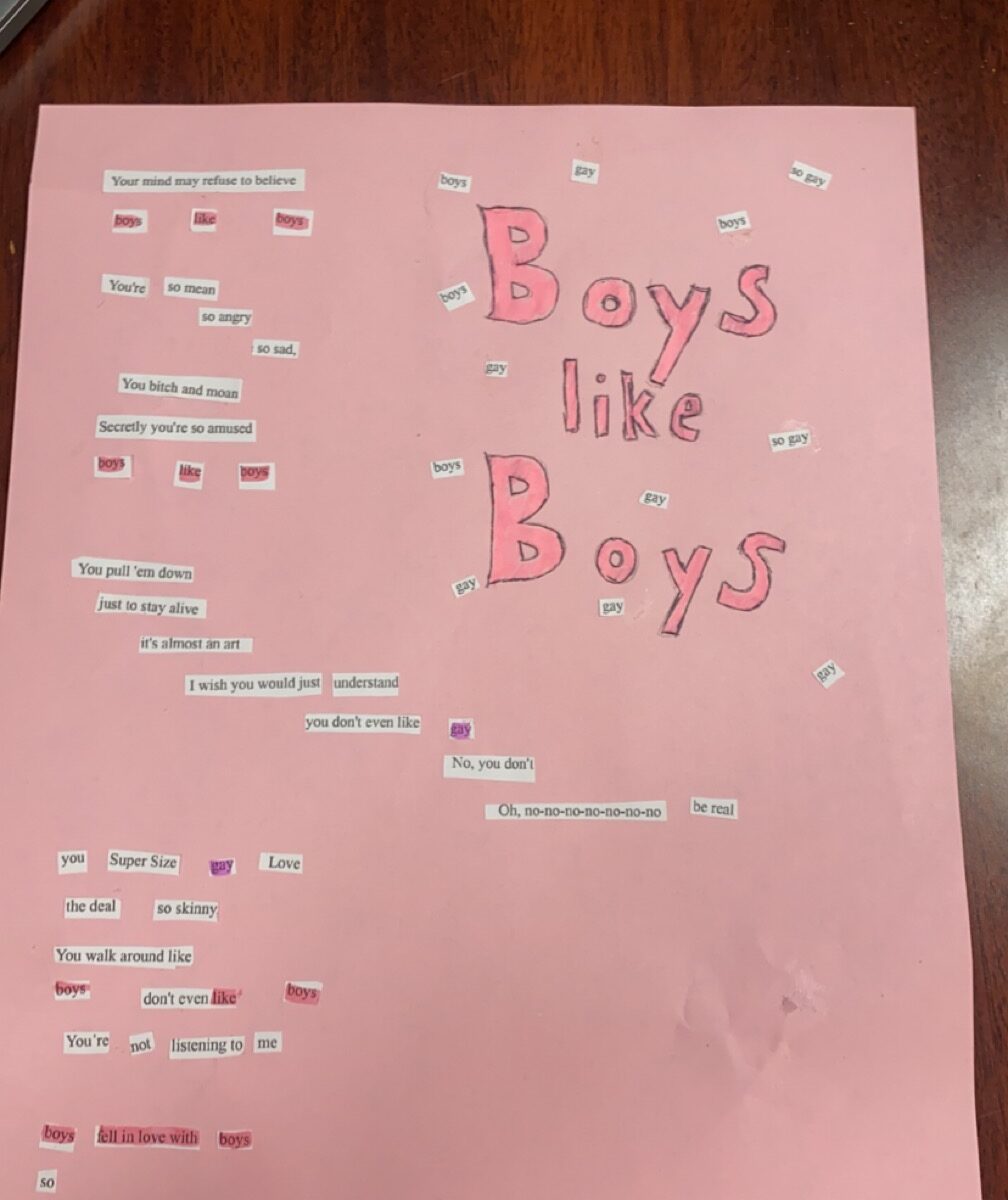
My found poem is based on “Ur So Gay” by Katy Perry. I found the meaning of this song to be homophobic with unwarranted resentment toward a boy who is homosexual. Throughout the song, she tells of how she fell in love with a boy who has stereotypical qualities and characteristics of a gay man. This causes her to judge him for acting or appearing as gay and her anger in the song manifests into negativity towards LGBTQ people as a whole. This song is very frustrating for me to listen to because of the perspective being so pessimistic about something that her love interest cannot control. The publication of this song was in 2007 and I do not think she understands how it could be perceived. Though it may seem like an innocent disappointment in a crush, LGBTQ people can be easily hurt by her choice of words and the context of the narrative.
I really like this assignment because I was able to change it into a response to her underlying homophobia. I made it so the speaker of the poem is challenging her views as seen through the repetition of “boys like boys”. My work intends to call out people who are homophobic and asks them to look inside themselves to assess where the hatred is coming from. It goes through feelings of denial, anger, sadness, and generally not listening to other people’s points of view. A possible interpretation of my new found poem can be that the speaker is calling out to people who are internally homophobic since the aggressor is gay themselves. This can be seen in the lines “Your mind may refuse to believe” and “You pull ‘em down just to stay alive” insinuating that the people who say hate speech do it as a way to repress or deny their own feelings of homosexuality. Overall, I think the spin of the original is a stark contrast and aims to recognize the unfair oppression and challenging viewpoints of people who are queer.
Benjamin Garcia Extra Credit
During the reading with Benjamin Garcia, he mentioned his personal experiences living as a homosexual person of color and how it influences his writing. Given that he began his college career as a biology major, he draws a lot of inspiration from the natural world. He mentions animals a lot and many plants. I like how he was able to take characteristics from certain species and relate them to his personal life and experiences. The reference to the corpse flower was especially interesting to men and I enjoyed the analogy of living one’s truth and not living simply to please people. As someone who enjoys writing, I took a lot of inspiration from his methods and techniques. My mindset changed when he was saying that failures are learning experiences and still teach valuable lessons for later work. The part as well about him not staying within the rigid confines of the genre was insightful as well. His last poem about the tacos was incredibly unique and he made many clever analogies. The implementation of humor makes the poem enjoyable to hear but there are many underlying themes that are relevant to society and topics in his personal life. He added many details in the poems he read about his family and poverty which reminded me of A Raisin in the Sun. His experiences as a person of color are not something I can personally relate to, but his detailed accounts of growing up with the culture were inspiring to hear. I also really liked how he talked about natural disasters and hurricanes as well as unpleasant flowers to show the complex, displeasing ways that nature can be. Before the reading, I went to the workshop and he gave very good advice and writing exercises that I will be using in the future. The general theme of the generative workshop was memory and he had us focus on one random object. From there we described it and came up with two others following the same process. He had us write about the connections between them and he used one of his poems as an example. I thought it was fascinating how he could create such a compelling, cohesive piece of work from the image of coffee on sponges, hummingbirds, and lungs. He had us take three keywords inspired by the random objects and stem words off of them, then create sentences and stimulate creative work. This exercise, though seemingly simple, created very complex and thought-provoking ideas and I will for sure use this tactic in the future when I am in a writing slump. He mentioned how he can bend the reality of past events and it helps him process what happened. This creates different emotions and helps live the events out in different ways. I liked how he mentioned characters and books within his own pieces and the allusions enhanced their relatability of them. Almost everyone knows the story of Harry Potter and I like how he connected it to his own story in a way that many people can understand. The workshop and reading were impactful and I learned about writing tactics, his personal struggles, and ways to approach writing to have positive outcomes.
Hey I’m Lauren
Hi everyone I’m Lauren Abarno. I am a freshman and my major is adolescent ed: English. I am from Dix Hills which is in Suffolk county. I really love reading and writing so I am very excited to get into this class and start all of the wonderful books. I also enjoy watching hockey as well as spending time with my friends, family, and of course my two cats. I can’t wait to get to know all of you 🙂
 Skip to content