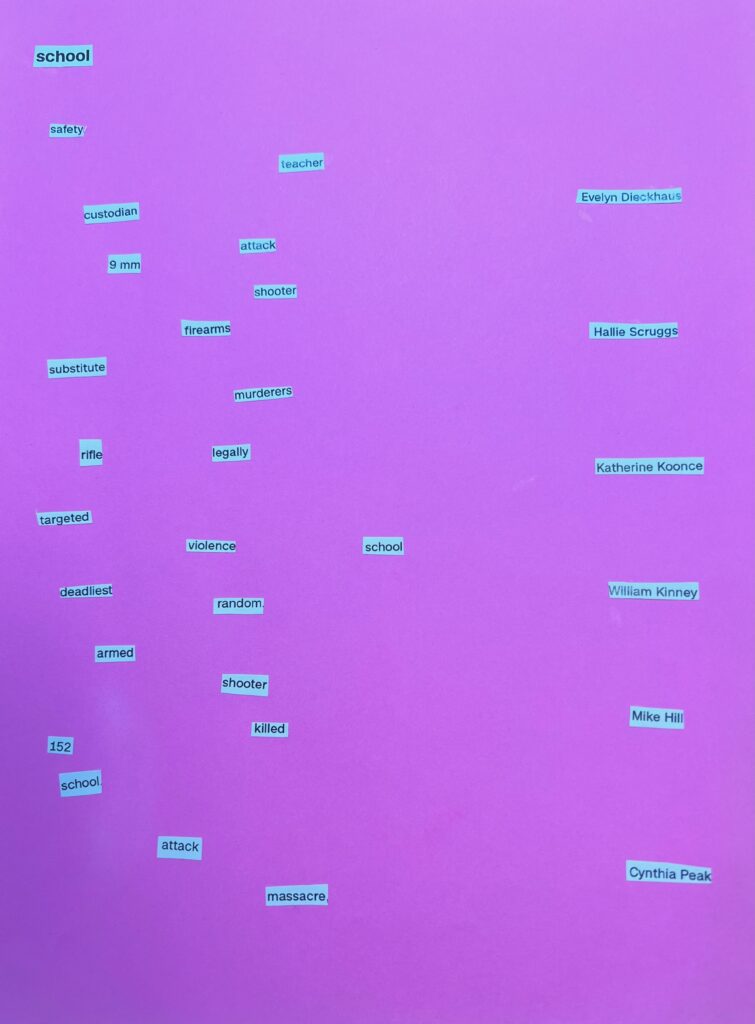
Victims of School

In creating my poem, I chose to put the victims names of the recent Nashville School Shooting on the right side of the page with large spaces separating the other words. I did this so there would be a pause separating the words with the victims names, which gives more significance and meaning to the victims, helping to pay respect to them. I also chose to put the word “school” centered in the middle of the poem. My reasoning for this is to remind us while reading it that we are talking about schools. Many of the other words on the page are about violence, guns, and attacks, so I put school in the middle to remind the reader that these are things connected to schools. Not the military, not wars, not the police, schools. Creating this found poem gave me a lot more respect and admiration for M. NourbeSe Philip’s work, Zong! While reading this book and glancing through it, it seemed like these words were thrown onto the page completely randomly, maybe even without meaning. After creating my own poem I realize how carefully each word is chosen and placed on the page and the deep meaning behind them.   

I chose to create this poem because of the anger and sadness I feel every time I think about school shootings. I am in school to become an early childhood education teacher, so every time a school shooting occurs, it breaks a little part of my heart. Schools are supposed to be safe places where students go to learn and socialize with their friends, not where they should have to worry if they are going to make it through the day. As a future educator, in our college classes we focus primarily on curriculum and lesson planning, but lately we have had to focus on what we would do if a shooter came into our school or classroom. This is something that no teacher, student, or parent should ever have to worry about, although unfortunately it has become increasingly more common. I am also angry that the countless lives that have been lost due to school shootings are not enough to make real change and end the killings.

Distinct Voices in Literature- Benjamin Garcia

The event attended was a Distinguished Voices in Literature Event. The speaker of this event was Benjamin Garcia. He shared many of his poems with us in the Corey Union Fireplace Lounge. He is a writer, in particular a poet. The book that he was sharing with us was Thrown in the Throat. This is an award winning book that won the National Poetry Series and the Eugene Paul Nassar Poetry Prize. He prefaced his reading by letting us all know that the thing most important to him in poetry is fun and enjoyment. He let us know that there would be things from his poetry that we would most likely not understand, but he hoped that we could at least enjoy it. I definitely enjoyed all of the poems he shared, even the most complex and complicated poems. He showed great emotion while sharing his poems and made you care deeply about what he was saying, even when you didn’t fully understand it. My favorite poem of his was the last one that he shared which is a newer poem and not a part of Thrown in the Throat. This was “the Taco Poem”. It was so fascinating to me how he could take such a simple thing, a taco, and create such a deep story surrounding it. He uses mundane words and creates such beauty out of it. 

One theme from all of his works centered around language. You could tell listening to his poems that every single word he spoke had a deep meaning behind it. Many of his poems centered around language which is also something that we talk about in class. In both works that we have read so far, it is very important to understand the language that the author is using to fully understand the meaning of the text and this was reinforced in his reading. Garcia is an immigrant which influenced some of the poems that he shared. This became a parallel to me with Maxine Kingston’s memoir The Woman Warrior. Kingston is also an immigrant, from China, and this is a big part of her life and shapes her memoir. Garcia shared with us that most of his poems are not non-fiction, they are shaped by his life experiences but are not fully factual which also relates to Kingston’s memoir. A memoir is not an autobiography, it is not fully factual, it is Kingston using her life experiences and can be subjective. I thought that this was an important parallel between the two pieces of work. Another connection that I drew was to A Raisin in the Sun when he mentioned that he grew up very poor and his living space was very compact with too many people in it. This was a lot like how the Youngers were living and I thought that was also an interesting parallel. 

I think that the Q and A at the end of the event was very insightful. He gave a lot of advice to writers but could also just be life lessons for everyone. He told us that we cannot be afraid to make mistakes and that mistakes can lead to beautiful things. I think this is important in writing where the first draft of a piece is never to its fullest potential. This is also insightful to life in general. We should not be afraid to make mistakes, we never know what is going to come out of mistakes. He shared with us that many mistakes that he made in his writing actually make his writing better and stronger. He also shared with us that we need to give ourselves permission. Permission to write what we want, but also to be who we are, like what we like, and dislike what we dislike. I loved that I attended a poetry event but left with valuable life lessons as well.

A Raisin in the Sun Act 2

Lorraine Hansberry’s A Raisin in the Sun conveys the struggle of racial discrimination in the early to mid 1900s Chicago, through the Younger family and their pursuit of bettering their housing situation. The play starts with the Younger family living in an undesirable situation. A small, crowded two bedroom apartment in which Travis has to sleep on the couch in the living room, and they have to share a bathroom with their neighbors. The living room is described as having to “accommodate the living of too many people for too many years.” (Pg. 23) and the furniture is referred to as “worn.” (Pg. 23) This family is packed into a space much too close together, and are constantly physically and emotionally bumping into the other members of their family. All of this changes when Mama gets a $10,000 life insurance check after the death of her husband. 

It had been Mama’s dream for years to move out of their apartment and into a house where she can have her own garden. “Well, I always wanted me a garden like I used to see sometimes at the back of the houses down home.” (Pg. 53) Mama decides to finally make these dreams a reality and she buys her family a house. Everyone is so excited for the news until Mama tells them where they are going to move- Clybourne Park. Ruth says, “Mama, there ain’t no colored people living in Clybourne Park.” (Pg. 93) Mama responds that the reason she bought the house where she did is because “them houses they put up for colored in them areas way out all seem to cost twice as much as other houses. I did the best I could.” (Pg. 93) This speaks to not only the Younger’s housing situation, but Chicago’s housing situation as a whole during this time period. This was due to a legal practice called redlining in which African Americans could be charged more for homes where other African Americans lived due to the area being considered a risky investment, and kept costs down for houses in predominantly white areas. “Anywhere where African-Americans lived, anywhere where African-Americans lived nearby were colored red to indicate to appraisers that these neighborhoods were too risky to ensure mortgages” (Gross) While white people had better jobs and better income, they also had access to better, safer housing at a lower cost. The options for black families at this time was to continue to live in overcrowded apartment buildings or pay more than double for a house in a predominantly black neighborhood. Mama decided she was finally going to live out her dream and buy her family the best house that money could afford, regardless of the ramifications that might come their way. 

Concerns about the safety of the Younger family in this new neighborhood begin to arise and are propelled by the visit of their neighbor, Mrs. Johnson. While appearing to make a normal visit to the Younger family, Mrs. Johnson shares the news of a black family that was bombed out of their home when they moved into a white neighborhood. She later says “I bet this time next month y’alls names will have been in the papers plenty- NEGROES INVADE CLYBOURNE PARK-BOMBED!” (Pg. 102) This ignorant comment further raised concern for Mama and Ruth about their safety moving into an all white neighborhood. While Mama took all of this into account before buying the home, she was not trying to put her family at risk, integrate into the middle class, or attempt to take a large stand against discrimination. She was just trying to achieve their dreams and have a better living situation where the whole family could be happy. Not only did this quote raise awareness to the Youngers of the danger they would be facing, but also to the readers. Ransberry was letting the readers know the true danger of racial discrimination at this time, which could be the cost of their lives. 

Racial discrimination was largely symbolized through the character of Mr. Lindor. He is the representative of the Clybourne Park Improvement Association. He shared a visit to the Younger’s apartment in which he appeared as if he just wanted to have a civilized talk with them. He says “that we don’t try hard enough in this world to understand the other fellow’s problem. The other guy’s point of view.” (Pg. 117) Instead, he had an ulterior motive. This motive was to tell them “our association is prepared, through the collective effort of our people, to buy the house from you at a financial gain to your family.” (Pg. 118) The people of Clybourne Park were willing to do just about anything to keep a black family from moving into their neighborhood and ruining their perfect suburbia. Mr. Lindor truly thought this plan would work and was not prepared for the stand the Younger family took against him when they told him, in no uncertain terms, no. He was outraged by their response and then said “well- I don’t understand why you people are reacting this way. What do you think you are going to gain by moving into a neighborhood where you just aren’t wanted…” (Pg. 119) His passive aggressive tactics to convince the Youngers not to move into his neighborhood was unsuccessful. The Younger family was going to achieve their dreams and better their housing situation regardless of the racial discrimination surrounding them. 

Discussion Questions:
1- The scene with Mrs. Johnson was taken out of many editions of this play according to Robert Nemiroff. How did this scene deepen your understanding of racial discrimination throughout the play? What emotions did this scene convey for you and the Younger family? 

2- How did the character of Mr. Lindor symbolize racial discrimination? What quotes from him stood out to you the most? 

Citations: 

Gross, Terry. “A ‘Forgotten History’ of How the U.S. Government Segregated America.” NPR, NPR, 3 May 2017, https://www.npr.org/2017/05/03/526655831/a-forgotten-history-of-how-the-u-s-government-segregated-america. 

Hansberry, Lorraine. A Raisin in the Sun. Vintage Books, 1994.

Hi, My Name is Lauren Kruger

My name is Lauren Kruger. I am a sophomore and an Early Childhood/Childhood Education major. I am from Long Island. I have three sisters, two nieces, and two nephews so I come from a pretty large family. I work at a vineyard on Long Island, which I really enjoy. Some hobbies that I also enjoy are reading fictional books, going to the gym, playing with my puppy, and listening to music.

css.php Skip to content