
Zong! is a found poem, created entirely out of a court case known as Gregson v. Gilbert. As we know, found poetry is created by taking the existing versions of text and rearranging, reframing, and cutting out words to form a new, poetic meaning. In this case, M. NourbeSe Phillip uses this court case as the basis for Zong! because the Africans being fought for in the case were viewed entirely as commodity, not as human.
I’d like to draw attention to the first couple of pages of the chapter.
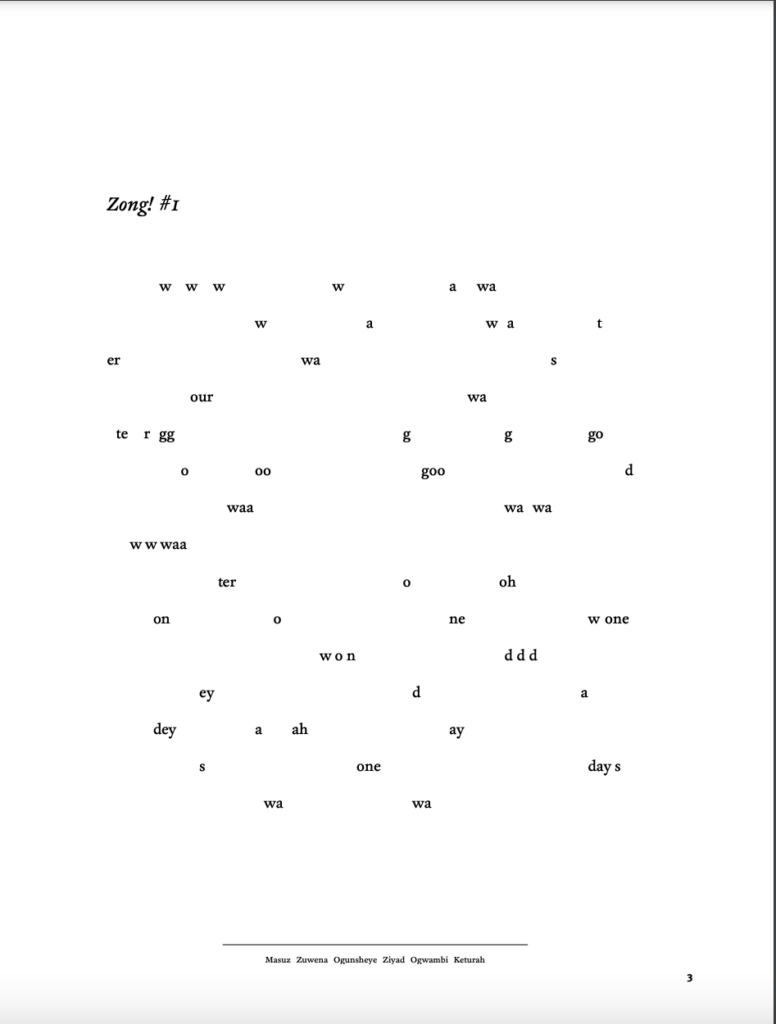
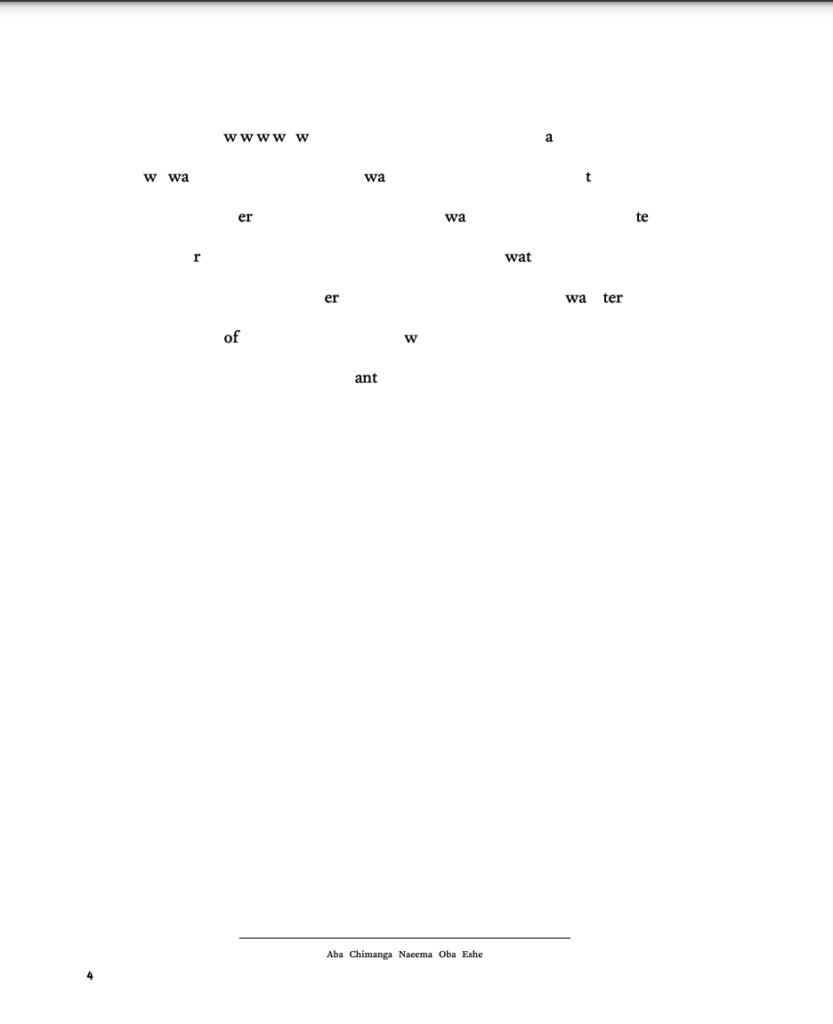
Did you all read these lines aloud when you were reading the book? How did it sound? Very faint, out of breath perhaps. You can see that words are almost formed and never spoken in full. Cut off constantly, never able to actually speak or form anything for us to hold onto. These pages are meant to simulate the sounds of drowning, using only the spliced words and repeated sounds of the court case. These morbid pages are included to demonstrate the true monstrosity of this massacre, making the reader understand that the Africans had no say in their fate this for day.
Phillip uses the court case to highlight many factors of this journey, including weather, time frame, and the Africans on board themselves. Phillip tells, “. . . of sea and perils of water (one day) water— day one . . . of months . . . of weeks . . . of days . . .of sustenance lying dead” (9.) Sustenance is referring to the slaves onboard, as they are lying dead after days and weeks at sea, facing what the court case calls the perils of water. Sustenance specifically means a food or drink capable of replenishing strength. I think using this word as she does is significant because she is framing the Africans as cargo, but she is able to highlight the value of the person themselves. The emphasis on timing also draws the reader in on the horror of the situation. They were on the sea for months! They had no comfortable food source and were being treated quite literally as insurance money, despite being in unthinkable situations suffering; women, children, families.
Disregarding human life as this is disgusting and unthinkable, which is why I think it is significant that it is written out of the court case. As Phillip says, “The conversion of human into chattel becomes an act of transubstantiation the equal of the metamorphosis of the eucharistic bread and wine into the body and blood of Christ. Like a magic wand the law erases all ties — linguistic, societal, cultural, familial, parental, and spiritual;” (196) By taking away their identity as African people, reducing them to slaves/chattel, they’ve had their stories hijacked. Reducing them to nothing but objects, despite the fact that they have diverse lives, cultures, and value on their own. These were stories which deserved to be heard and lived. They were not commodities, they were people. “Without life in life —with a story that cannot but must be told” (196.)
Discussion Questions
- What did you guys think of the first couple of pages? Did you read them aloud as well? What did you think was happening/trying to be shown?
- Do you think the way this book is told changes your interpretation? Are you truly capable of getting their stories when its’s told this way? Was this vagueness intentional?
Works Cited
Philip, M. NourbeSe. Zong! Wesleyan University Press, 2008.
 Skip to content