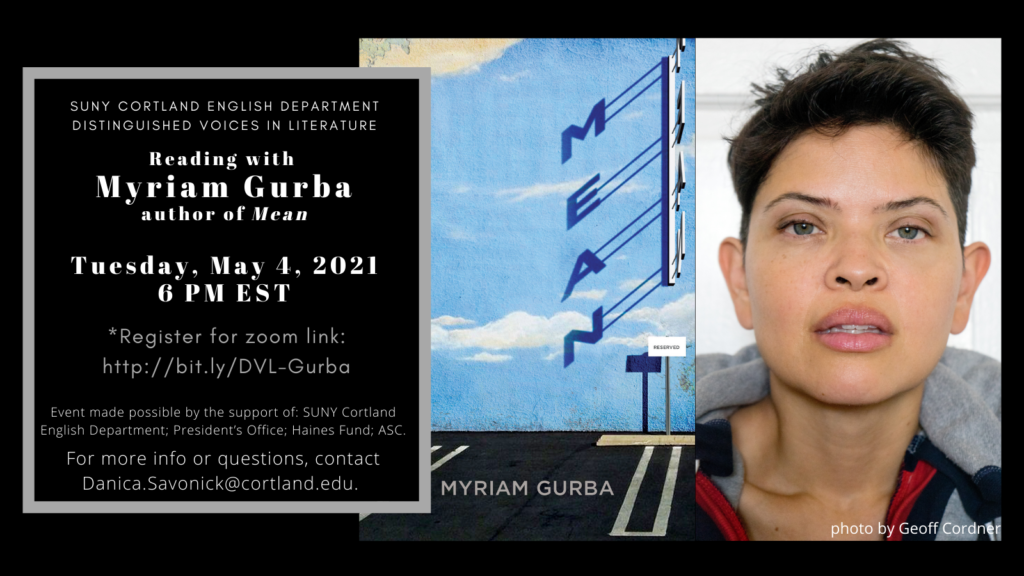
Myriam Gurba describes the traumatic experience that she faced with an unknown man in her book Mean. The man who assaulted her was also responsible for the brutal deaths of other women, which Gurba describes as well. The event Gurba has gone through has traumatized her completely, making the world she once lived in unrecognizable. “After he touched me, it seemed like every fragrant bush might be holding him” (Gurba 120). When going through something so traumatic, the once joyful and familiar world around oneself is shattered. For Gurba, a recognizable, safe place has now been invaded and stripped of its safety. She would also see him in places where he would not. “Somehow I became queasy while simultaneously leaving my body. He was approaching me” (Gurba 125). Even in the grocery store with her mother, her fear would be activated by slight resemblances to her attacker, which haunted her everywhere she went.
This was not the only thing that haunted Gurba; however, she was also haunted by guilt, more specifically survivor’s guilt. According to a study Survivor Guilt: A Cognitive Approach published through the National Library of Medicine, survivor guilt is “a common experience following traumatic events in which others have died”. The perpetrator who raped Gurba also assaulted and murdered numerous other women. Being a survivor, Gurba lives with the survivor’s guilt for having survived. Sophia Torres was the woman we were introduced to at the beginning of the book and who we came to find murdered by the man who raped Gurba. Gurba feels a connection to Sophia because of their shared experience, but she also feels the immense guilt of being a survivor. “It’s not fair that I’ve had so much privilege. And by privilege, I mean life. The privilege of surviving doesn’t feel good. It makes me feel guilty” (Gurba 112). Gurba is not able to cope with her own experience because of her guilt that she survived her attack. She compares the lives that she and Sophia lived and points out the physical differences in wealth, or “privilege” they both experienced. This led her to the real privilege she was worried about, which was surviving her experience. Gurba is unable to process her own encounter with this man, but additionally, dealing with the guilt she faces is what is truly disturbing her. In the section “Siluetas” Gurba states, “When you have PTSD, things repeat themselves over and over and over. Guilt is a ghost. Guilt is a ghost. Guilt is a ghost” (Gurba 116). Gurba is now verbally relating her guilt as haunting her; it is like a ghost, one that is constantly there to remind her. Gurba did not have any involvement or control over what the man had done to her or what he had done to others. In this quote, Gurba is open to admitting that she has PTSD from the experience, but she never explicitly states she has survivor’s guilt. She is guilty because she survived, but she is not open to admitting this. This section was important because we see to what extent Gurba feels guilty for the murder of Sophia Torres, describing how she feels guilty every year on her death anniversary. Gurba places flowers on the home plate of the field she was assaulted on to pay tribute. Gurba’s actions show not only her good heart to pay homage to a woman she never met nor was responsible for the death of, but also how she chooses to vent her grief in physical forms. In some ways, this can be seen as a positive coping mechanism for Gurba to have a physical expression of honoring the life of someone she feels guilty for. A scene I felt captured another reason why Gurba felt guilty was in the section “Albatross” where Gurba describes what thoughts are constantly in her head about the attack, one of which is what she could have done differently in her situation.
“The timing of the attacks, as reported by the news, made me first… If I’d chased him into that alley, caught up to him, taken off my shoe, and beaten him with it like Mom taught me to do with cockroaches, then he wouldn’t have been out stalking, grabbing, and mutilating women. He might’ve turned around and killed me, but that would have been OK. Then I wouldn’t be living with this guilt. This guilt was an invisible but heavy albatross hanging around my neck (That’s a reference to Coleridge’s The Rhymer of the Ancient Mariner)” (Gurba 139).
I feel this section of the text is the most important in describing Gurba’s survivor’s guilt. Some victims try to replay the events they experience, thinking of different actions that could lead to different outcomes. Whether she had killed her assailant that night or died herself, she would not be alive to experience the feelings she does. The section is titled Albatross, which, as Gurba describes, is a reference to a poem by Samuel Coleridge. The poem is about a group of sailors who are on a voyage, and while traveling, an albatross flies alongside the ship. While the bird was there, it brought good weather, but it also brought storms, so one day one of the mariners killed the albatross. The weather cleared after the death of the bird, and the sailors rejoiced, but once bad weather returned, the sailors blamed the man who shot the bird, forcing him to wear the corpse of the albatross around his neck. The man is guilty for killing the bird, and he feels responsible for all his friends’ deaths that were triggered by the bird’s death. Similarly, Gurba wears the corpse of the albatross around her neck. Her actions were not related to any other tragedy that occurred to the other women, but she still feels guilty as if it were her fault, as if the deaths of these other women were triggered by her rape.
Throughout the book, Gurba is extremely intimate with the experiences in her life, she uses humor, pop culture references, and many more techniques to present her ideas in unique ways. She is able to balance the contrast of humor with the severity of topics like rape and sexual assault. I believe that Gurba suffers from survivors’ guilt because of the rape she experienced.
Discussion Questions
- How does Gurba’s PTSD coincide with her survivor’s guilt? Are either heightened due to the presence of the other?
- Do you think Gurba’s inclusion of the albatross reference was helpful or distracting to the experience Gurba was sharing?
Works Cited
Coleridge, Samuel Taylor. The Rime of the Ancient Mariner. Dover Publications, 1992.
Gurba, Myriam. Mean, Coffee House Press, La Vergne, TN, 2017, pp. 110–126.
Murray H, Pethania Y, Medin E. Survivor Guilt: A Cognitive Approach. Cogn Behav Therap. 2021 Sep 16

 Skip to content