
Zong! is a found poem, created entirely out of a court case known as Gregson v. Gilbert. As we know, found poetry is created by taking the existing versions of text and rearranging, reframing, and cutting out words to form a new, poetic meaning. In this case, M. NourbeSe Phillip uses this court case as the basis for Zong! because the Africans being fought for in the case were viewed entirely as commodity, not as human.
I’d like to draw attention to the first couple of pages of the chapter.
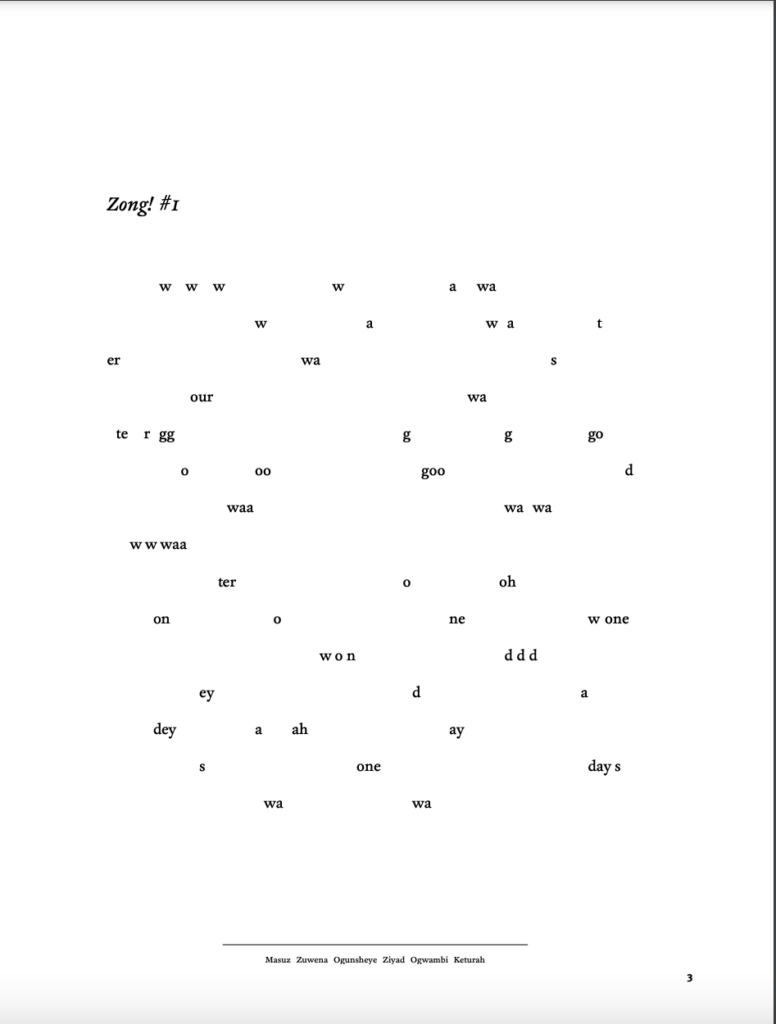

Did you all read these lines aloud when you were reading the book? How did it sound? Very faint, out of breath perhaps. You can see that words are almost formed and never spoken in full. Cut off constantly, never able to actually speak or form anything for us to hold onto. These pages are meant to simulate the sounds of drowning, using only the spliced words and repeated sounds of the court case. These morbid pages are included to demonstrate the true monstrosity of this massacre, making the reader understand that the Africans had no say in their fate this for day.
Phillip uses the court case to highlight many factors of this journey, including weather, time frame, and the Africans on board themselves. Phillip tells, “. . . of sea and perils of water (one day) water— day one . . . of months . . . of weeks . . . of days . . .of sustenance lying dead” (9.) Sustenance is referring to the slaves onboard, as they are lying dead after days and weeks at sea, facing what the court case calls the perils of water. Sustenance specifically means a food or drink capable of replenishing strength. I think using this word as she does is significant because she is framing the Africans as cargo, but she is able to highlight the value of the person themselves. The emphasis on timing also draws the reader in on the horror of the situation. They were on the sea for months! They had no comfortable food source and were being treated quite literally as insurance money, despite being in unthinkable situations suffering; women, children, families.
Disregarding human life as this is disgusting and unthinkable, which is why I think it is significant that it is written out of the court case. As Phillip says, “The conversion of human into chattel becomes an act of transubstantiation the equal of the metamorphosis of the eucharistic bread and wine into the body and blood of Christ. Like a magic wand the law erases all ties — linguistic, societal, cultural, familial, parental, and spiritual;” (196) By taking away their identity as African people, reducing them to slaves/chattel, they’ve had their stories hijacked. Reducing them to nothing but objects, despite the fact that they have diverse lives, cultures, and value on their own. These were stories which deserved to be heard and lived. They were not commodities, they were people. “Without life in life —with a story that cannot but must be told” (196.)
Discussion Questions
- What did you guys think of the first couple of pages? Did you read them aloud as well? What did you think was happening/trying to be shown?
- Do you think the way this book is told changes your interpretation? Are you truly capable of getting their stories when its’s told this way? Was this vagueness intentional?
Works Cited
Philip, M. NourbeSe. Zong! Wesleyan University Press, 2008.
 Skip to content
Hi natalie,
Throughout your blog post I liked how you asked questions about how our thought process went with the spacing of the words. It’s almost impossible to skip over the pages because we are so used to reading full pages. The fragments of language taken from the court records of the Gregson v. Gilbert’s case can closely relate to the separation of the words that can translate to the breakage of African American society. The format also reflects the enslaved african americans to be referred to as “cargo” or “goods’ ‘. “Given that the insurance was not recoverable, the owner’s cast the cargo overboard” (187) The use of the word “cargo” to refer to human beings reflects the dehumanization of the enslaved Africans They are seen as objects and nothing more. So to answer your first question I thought the first few pages were powerful in a sense of the silence those half empty pages give us. Which can closely relate to the silence among the African American community. Alot of books we read are so full of words and ways in which our intercultural relationships are tested, but it’s different in Zong. Zong wants us to hear and recognize that with all the commotion of this ongoing issue there are also feelings of loneliness and darkness. When I first saw this page I didn’t read it outloud but I did after reading your blog post. I felt confused reading it if i’m being honest but i like to think that was the point. The repetition of phrases served to emphasize the brutality and inhumanity of the event.
Buckingham, M. E. Zong, New York, 1934, pp. 187–188.
Hey Natalie! Great blog post.
I really appreciate your analysis of this section of the book. The first time I read it I did not read it aloud, but after reading your blog question, I decided to reread it aloud; I must agree that reading it aloud gives new meaning to the words. While reading this section, I found the breaking up of the words to emphasize the weakness, or brokenness of the people that were in this situation. The feeble syllables and splitting of the words parallel the state of the people, or how they were referred to in the case “cargo” and the way that they are broken from their homes and humanity. The vagueness of the writing style is intentional. Since it is unclear at first, you are forced to think about the meanings behind the words more. This thought process intrinsically emphasizes the suffering, and dehumanization of the people discussed in the case. “w w w w wa w wa wa t er” The splitting of the words, when read aloud sounds as if each syllable hangs in silence until the next syllable harshly breaks it again, often with a feeble repetition.
Philip, M. NourbeSe. Zong! Wesleyan University Press, 2008.
Hello Natalie good work with your analysis of how the authors broken words give emphasis to the broken speech she is writing. The first time that I read the book I did read it allowed because I couldn’t piece together the first part of the chapter. I found “Zong #2” a lot easier to read but still making sense of the literature takes multiple reads and a lot of mental work. I like your analysis because it helped me to better remember what the book was about when thinking of the broken linguistics incorporated in found poetry. The way you chose to analyze the authors ties back to slavery and discrimination it really helped me to decipher some of the more complex lines like “…sustenance is the ship is the captain is the crew is perils is the trial is the rains is the seas is currents is Jamaica is Tobago is islands…”. This part of this line in context to slavery most likely makes reference to the middle passage and the slave trade ships that sold Africans to the Caribbean islands to work on sugar cane farms. without your analysis of how it all connects back the forth time I read this I probably would not have gotten what this section is hinting towards.
Hi Natalie! I found your blog post very well-written and thought provoking. I did not try to read the first few pages out loud, but after hearing your interpretation, doing so would definitely add more depth to the piece. I interpreted the first few pages similarly to you, as a person trying desperately to speak but being physically unable to. Some of the words and phrases that jump out on these pages are “water” (for obvious reasons after reading the article), “one day,” and “water of want” broken up at the end. “One day” could be seen as a declaration of revenge, as in one day you will get retribution for what you have done and these people will receive justice. “Water of want” could symbolize the greed that caused this tragedy to happen in the first place; the slave traders’ want for money and cheap labor caused innocent lives to be lost in the water. The vagueness of the storytelling was purposeful because it immerses the reader in the same murky confusion and fear that these people felt while being thrown overboard. We are not truly capable of getting their stories this way, which represents the fact that their stories never had a chance to fully unfold.
Hi Natalie! I thought you had a great blog post and did an excellent job explaining the Zong Massacre. To answer your first question, I did have to read the pages aloud and had read these pages a few times. Initially, reading these beginning pages, I was very confused about what was going on. However, as I continued to read, Philips gave more information, and that helped me piece everything together. After giving it a second and third read, I thought the way Philips framed her poems added to the purpose. For example, Philips says, “The good of overboard justified a throwing of property fellow creatures become our portion of mortality provision a bad market negroes want for dying” (Philips 16). Reading this as just a big sentence would confuse a reader and doesn’t portray the author’s point as efficiently. The fragmented phrases represent the words being said by someone enslaved who is starving, drowning, and dying on this ship. It is as if the individual can’t get the whole sentence out. Philips uses different stylistic features to better represent the stories of what was happening to the enslaved people on the ship.
Hi Natalie! I truly enjoyed reading your blog post, it was extremely thought-provoking as it opened a new way for me to interpret M. NourbeSe Philip’s work. As it was thought-provoking it was also extremely confronting. When I pass a piece of literature (typically poems) I don’t think I would comprehend reading, I tend to skim over that section of the book if I can, if that makes sense. Your blog post challenged me as it made me go back to and reread the first part of the chapter (this time aloud and more than once). Reading aloud helped me further digest and understand Zong! Rereading it, I realized, like Rankine Citizen, Zong! also emphasized and represented society/ us again, and at times the individual discussed. Through the emptiness on the page and repetition, we once again see the inhumanity and injustice society fosters represented on the page. “How did they- the Africans on board the Zong- make sense of what was happening to them? What meaning did they make of it and how did they make it mean? This story that must be told; that can only be told by not telling.” (Philip 194). Making sense out of the nonsense. When Philip says this it brings me back to the first couple of pages. This to me creates a parallel between the first couple of pages and how in a sense it is ironically supposed to not make sense because the story that must be told can’t be told by telling.