Extra Credit Opportunities

Here are the 3 remaining extra credit opportunities for the semester. All are due the same time as the course reflection: 11:59 pm on Tuesday, May 9.

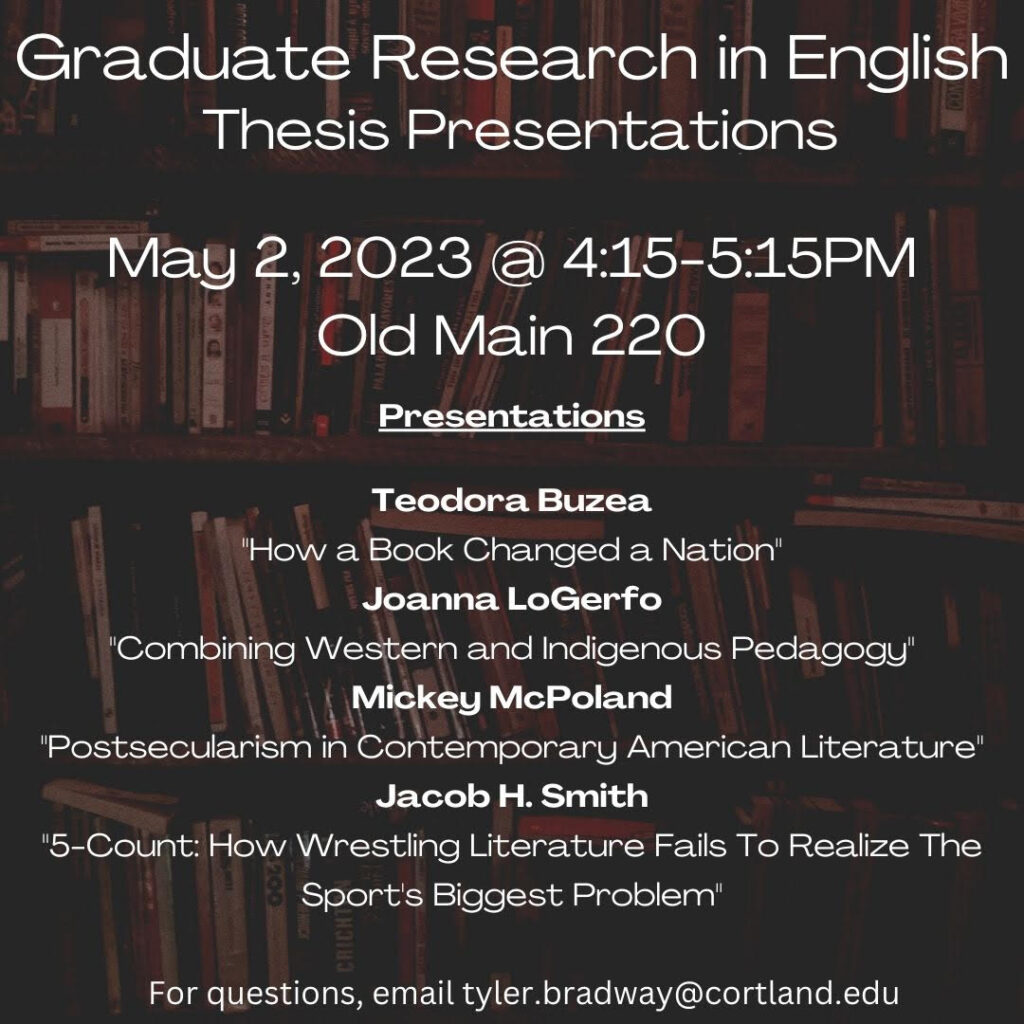
  1. Attend the Graduate Research in English Thesis Presentations and write an event review (instructions below)

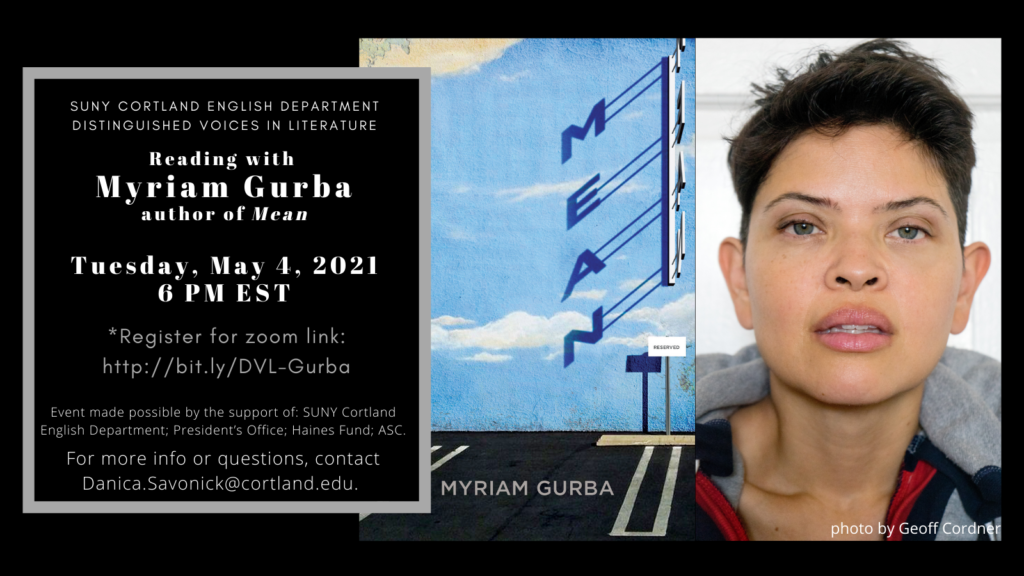
2. Watch the video from Myriam Gurba’s event at SUNY Cortland (2021) and write an event review (instructions below)

3. Blog post about Episode 1 “Democracy” of the 1619 Project (Hulu). 

  • Watch Episode 1 “Democracy” of the 1619 Project (Hulu). 
  • Write a blog post connecting the episode to our course readings and discussions (especially of Citizen).
  • Also consider: what stood out to you as most interesting and important? 

Event Review Instructions

  • Who, what, when, where, why; a report of what happened; highlights; what you learned
  • Identify connections to course readings, concepts, or discussions
  • Photographs and images from the event are welcome
  • Aim for 500 words or two thoughtful paragraphs
  • Post as a blog

The reality of the world we live in

In this class so far we continue to dissect the importance of being aware of the world around us and the relationship we create with self and the world. As human beings we are meant to accept, love and honor the life that was given to us, not question why we are put on this earth. With talking about rape and how this disturbing act can be possible for a human, Its important to question why our creator put on on this earth to experience such terrible things.  In Myriam Gurba’s memoir, “Mean,” she recounts her experience of being sexually assaulted by a man she did not know. While this particular incident does not directly involve the idea of rape with God, it highlights a larger societal issue of sexual violence against women. In some mythologies and religious traditions, the gods are depicted as having sexual relationships with humans or other divine beings. In some cases, religious texts have been used to justify or excuse sexual violence, particularly against women. For example The story of Dinah is a account of sexual violence against a woman in the book of Genesis. The story has been used to justify or excuse sexual violence against women. Our world was created on ideas that things like sexual assault and violence are not morally wrong. I believe that’s why our world now is so disconnected to what we deem is right and wrong. 

The section “Hella Ukiyo-e” in Myriam Gurba’s memoir “Mean” is a powerful way of expressing  themes such as sexual violence, humor, art and justice that run throughout the book. The term “ukiyo-e” refers to a genre of Japanese woodblock prints that were popular during the Edo period (1603-1868). “Hella” is a colloquial term that is commonly used in Northern California, where Gurba grew up, and it means “a lot” or “very.” Many ukiyo-e artists were considered to be outsiders, and their work often depicted marginalized groups such as women and lower-class individuals. These prints often depicted scenes of everyday life, such as landscapes and portraits. By combining these two meanings, I interpreted it as  Gurba Creating a juxtaposition between what we are unable to see and what we don’t see in our society. 

Omnipresence is defined to be a person that is present in all places at one time. In the section “Omnipresent” the reality of the world we live in is scary and unpredictable. Going to school she was watched by her teacher while being sexually assaulted, after her experiences anytime she walks out the door it’s like walking out onto a battlefield.  Do you think Gurba woke up and chose to be sexually assaulted? The real pain comes after your trauma. The scene where Gurba is in the grocery store with her mother shows that people never fully get over their trauma after it happens. She is scared because she convinced herself she saw her rapist and describes it as “I came back to my body almost immediately as I left it when I realized the shopper was not him” (Gurba 125)  The way I see it, it’s a feeling that shadows over you like a dark cloud. When you go through something that strips you of who you are and makes you question everything. You constantly live in a world surrounded by fear. I chose to focus on the chapter “Omnipresent” because it captures the reality of sexual assault. It starts off with comparing god to someone who is always present in our lives, he shadows over us and watches over us. God is seen as an all-knowing, all-powerful, and loving creator who is the source of all life and existence. So it’s hard for us to absorb when bad things happen because we were created from love and acceptance. But the point Gurba is trying to make is being aware that just because we were created from a good place doesn’t mean that the world is necessarily safe. “God is like rape. Rape is everywhere too. Rape is in the air. Rape is in the sky. Rape is in the bible” (Gurba 110) This felt almost uncomfortable to read because i would never associate the two words “rape” and “god” together. But Gurba does this to show her readers you never realize true pain until it happens to you. “A stranger chose me to rape” ( Gurba 110) The quote reflects the sense of violation and powerlessness that Gurba felt in the face of the stranger’s actions. By using the word “chose,” Gurba is highlighting the fact that the rapist made a deliberate decision to target her, emphasizing the intentional nature of the harm that was done to her. Gurba struggles with absorbing why she was chosen as a victim of rape. She’s in a constant state of “why me?”. Even the creator of our earth can’t protect us from the evil that comes with it. 

Discussion questions

  1. Have you ever experienced something that was so traumatic it felt like an out of body experience? If so, what was it and how did you cope with it? How did you feel reading the way Gurba is coping with her trama? 
  2. Do you think Gurbas purpose for comparing god to rape is something that is far fetched or do you think it clears up the reality that bad things in our world happen no matter who or what created us? 

Citations 

Gurba, Myriam. Mean, Coffee House Press, La Vergne, TN, 2017, pp. 110–126.

“Who Is the Victim in the Dinah Story?” TheTorah.com, https://www.thetorah.com/article/who-is-the-victim-in-the-dinah-story. 

PTSD: An exploration of mental health in Mean as expressed through implications of sexual assault

Throughout this segment of Mean by Myriam Gurba, readers are brought into the narrator’s life more deeply through personal experiences that shape the way she sees the world. In this noteworthy portion of the book, we are introduced to the highly prevalent theme of mental health in regard to society and her sexual assault. Through Gurba’s retelling of her own rape encounter and the numerous ways it haunts her presently, we are able to see the persistent effects mental health can have on a person. 

The harmful impacts of Post Traumatic Stress Disorder (PTSD) are implicated as Gurba explains the explicit and appalling details of her own rape. As per the fifth edition of the Diagnostic and Statistical Manual of Mental Disorders (DSM-5), PTSD is defined as “Intense or prolonged psychological distress at exposure to internal or external cues that symbolize or resemble an aspect of the traumatic event(s)”. It is apparent that Gurba is suffering from this, not only because straightforwardly she states so, but because of the gutwrenching side effects that continue long after her assault. She states, “Did you know PTSD is the only mental illness you can give someone? A person gave it to me. A man actually drove me crazy. He transmitted this condition” (Gurba 109). I find this quote very intriguing because her diction makes it seem as if mental disorders are something communicable such as the flu or measles, however, it is quite the opposite. Through her experiences, she developed this dreadful disorder that she carries around with her and she blames her abuser for transmitting the disease even though that is not technically feasible. 

Another example of this is when Gurba is grocery shopping with her mother and she sees a man who has a similar appearance to the individual who raped her. She has an intense wave of anxiety come over her which makes her feel as if she is no longer in her own body. This can also represent the way that after an assault, it is not uncommon for one to feel detached from their physical being due to the violation. She claims, “I came back to my body almost as immediately as I’d left it when I realized the shopper was not him. His was not the smile I still felt between my legs” (Gurba 125). Even the slight semblance of the man who raped her can have a strong influence on her, causing her to feel uneasy and even dissociated in an everyday setting. She follows these statements by proclaiming, “This shopper was some random homey, but for a sesame seed of a second, my mind transposed that face over this homeboy’s face. It blended them into one composite. The post-traumatic mind has an advanced set of art skills” (Gurba 125). Something that drew me into this was the way that the event was so disturbing that her mind plays tricks on her when faced with strangers whose faces she has never seen before in casual contexts. Then again, it is pivotal to remember that when she was assaulted it was unexpected and in a context such as the one she was in with her mother at the store. The fear and blindsides forced her brain to go into panic mode and a frenzy, not only because of the event that scarred her but because of the disease that it created.

A plot moment that was especially fascinating was when Gurba was speaking with the nurse in complete fear and disbelief to which she was hit with disrespect as well as a lack of sympathy and support. She was invalidated by someone whose job is to help her by being told “‘You’re going to have to get over this’” and “‘These kinds of things happen’” (Gurba 122). Sexual assault is not something to be taken lightly especially since it is a criminal offense and demolishes the mental state of the victim. This was very counterproductive for Gurba since she was already rattled by what happened to her. It is also crucial to understand that for people suffering from PTSD, it is not as simple as being told to “get over” the damage, and that offering insightful support is much more beneficial than negativity. I find the nurse’s approach baffling, principally for the fact that she is also a woman and is highly susceptible, unfortunately, to endure the same issues that Gurba did. Though it is something that happens all too common in society, it is not an issue to be brushed under the rug and played off as if it were nothing. 

This segment of the novel was interesting because we are shown the new and more intricate ways that Gurba handles trauma. When she was younger and was touched by her male classmate, she sat back anxiously and allowed it to happen. Now as an adult, she fought back against her abuser and did what she could to prevent it from happening again. She is no longer handling these difficult situations with childish immaturity but with a more sophisticated, thought-out approach and with a sense of impulsivity. Though she is plagued with lasting trauma and mental tumult, she has grown as a narrator as we learn more about her experiences and navigation through coping. The readers can see the good, bad, and ugly as she has to handle the ups and downs of these horrible circumstances but as our protagonist, we are able to recognize the growth and maturity she obtains.

Discussion Questions

  1. Do you think the advice the nurse gave Gurba was helpful or harmful? If you feel it is harmful, what could have been a more efficient or respectful approach that could’ve been taken?
  2. What are some ways Gurba reacts to sexual assault in school with Macaulay to now in college? How are her approaches similar? How do they differ?

Works Cited

“Understanding the Impact of Trauma – Trauma-Informed Care in Behavioral …” National Library of Medicine, 2013, https://www.ncbi.nlm.nih.gov/books/NBK207191/. 

Gurba, Myriam. Mean, Coffee House Press, La Vergne, TN, 2017, pp. 101–144.

FUNNY TRAUMA?

Mean is a memoir by Myriam Gurba, it covers the experiences of the author growing up as a queer, mixed-race Chicana in a middle-class American environment. Gurba’s writing style is casual, though the subject and events of the book are serious in nature. Humor is a staple in this book, this humor is extremely telling regarding Burga’s attitude towards her experiences. The writer employs humor as a tool to break up the depressing subject of the book, and to distract the reader from Burga’s pain; or in some cases to mask certain details in her experiences.  

Burga does not make a significant effort to tell humorous stories, the stories she tells leave natural places to insert a joke into the writing. The types of jokes in this book are tasteful for their respective situations, they do not overshadow the deeper implications and themes of the book but create a more accessible pathway for the reader to interpret what Burga is communicating. The joke is not the point; it is a tool to distract from negativity or mask details. Though humor can be used in this manner, it can also come across as callous, or making light of a situation that should be taken seriously. It is only due to the expert execution of this writing element by the author that she can tell her story in such a manner. “I breathed their asbestos; they flaked their cancer onto me. Besides the ceiling tiles, I was kept up by coffee, coffee became my closest friend that semester, coffee gave me everything I needed, coffee made my heartbeat faster and turned me into a speed reader, coffee turned me into a sweaty introvert (aesthetic boners).” Here, Burga is describing the decrepit, run-down, and dreary atmosphere of her first college dorm. She states that cancer is being flaked onto her, keeping her up at night. This is clearly not a pleasant experience she is telling of, yet she jokes about coffee in the next line. She says that coffee was her “best friend” and that it turned her into a “sweaty introvert.” These are intentionally humorous deliveries of these lines. The humor of this line immediately allows the reader to move on from the negative tone that is set by her dorm description. This could be taken as a hand-wave, or lessening of the previous subject manner, however, Burga writes so the extremely relatable coffee addiction joke becomes a natural transition into the next topic she would like to cover in her memoir. She tastefully integrates hyperbole about her feelings on coffee and the physiological effects it has on her in her description. This clever interweaving of humor into her writing allows Burga to tell her story in this way, providing a more engaging read as the humor is funny. By making the read more engaging the author encourages the reader to think more critically about what the real message is of her experiences. Not only does humor chop up the negativity of the text, but it also distracts the reader from the real pain that the author experiences over these memories, as well as an out for Burga to avoid discussing certain things she would rather leave untold. “If molestation is a circle, a circle of life, then isn’t the hand of every molester working through the hand of every other molester? It’s fair to say that Mr. Osman’s hand was working through Makali’s hand just like the Eucharist is no longer bread during mass it’s Jesus coming at you through a cracker (Bonnie).” Here, Burga is reflecting on Mr. Osman, the little league baseball coach of her junior high, who had been found guilty of molesting countless boys. One of Mr. Osman’s victims molested Burga during class, back in junior high, which caused her to reflect on how abuse is a cycle. This is an important idea regarding the nature of abuse and abusers, she says that the hand of one molester works through the hands of all other molesters. The author then interjects this by stating that it is like how the eucharist is “Jesus coming at you through a cracker”. Comparing the cycle of abuse where one molester’s hand “acts” through another to a cracker being Jesus is a very lighthearted approach. This lightheartedness deflects the reader from the pain that is likely being felt by Burga here while discussing such a grim matter. Burga’s humor creates a more engaging read for the reader while being a useful authorial tool for her to communicate her message.  

DISCUSSION QUESTIONS: 

Do you think Burga’s use of humor to lighten the situation enhances her points, or is it detrimental? 

What other aspects of Burga’s writing collaborate with her humor to enhance her message and light-hearted attitude? 

CITATION: 

Gurba, Myriam. “Pgs. 37-100.” Mean, Coffee House Press, La Vergne, 2017. 

The Significance of Dark Humor While Discussing Trauma, in Myriam Gurbas “Mean”.

In the book “Mean” by Myriam Gurba, one recurring motif is the use of humor as a coping mechanism in the face of trauma and oppression. Gurba uses dark humor throughout the book to address difficult topics like sexual violence and racism often using irony and sarcasm to comment on the absurdity of the situations she finds herself in. It states, “Of Course an elderly white dude taught anthropology. Who better to explain all the cultures and peoples of the world than he who is in charge of them?”.(p.90). By analyzing this motif, we can see how humor can be a powerful tool for marginalized individuals to resist and subvert oppressive systems. Gurba’s humor not only allows her to cope with trauma, but also serves as a way to call out the injustices and hypocrisies of the world around her. In this way, humor becomes a form of resistance, a way for Gurba to reclaim her power in the face of adversity.Furthermore, this motif can also prompt readers to consider the ways in which they use humor to cope with their own struggles and hardships, and whether their use of humor is reinforcing or challenging systems of oppression. Overall, by analyzing this specific motif within “Mean,” we can gain a new perspective on the power of humor as a tool for resistance and self-empowerment. Sexual violence is not just a personal trauma, but a systemic issue perpetuated by societal attitudes towards women and people of color, and that humor can be a powerful tool for coping with trauma and resisting oppression, challenging societal norms and expectations that would have survivors remain silent and ashamed about their experiences.

Overall, Gurba’s writing is characterized by a bold, provocative style that combines humor, imagery, and social critique to explore themes of trauma, identity, and power.Gurba’s use of vivid imagery and sensory details to create powerful, evocative descriptions of people, places, and experiences. Her writing is often visceral and raw, immersing readers in the physical and emotional realities of her own life and those around her. In the text she states, “The hand Macaulay wasn’t molesting me with rose to his snout.”.(p.25). I think that this quote helps us to truly understand the raw realness of her writing and how vulnerable and intense it is. This rawness and dark humour she uses to express her trauma gets through to us on a deep level and helps us to understand the true severity of sexual assault. In addition to these stylistic elements, Gurba’s writing is characterized by a strong social critique, which she uses to expose the contradictions and injustices of society. She is particularly interested in issues of power and oppression, and she uses her personal experiences as a mixed-race Chicana and queer woman to comment on larger social structures and systems.This makes Gurba’s writing is a bold and unapologetic exploration of the intersections of trauma, identity, and power. Through her use of humor, imagery, and social critique, she invites readers to engage with these themes in a deeply personal and often challenging way, challenging us to rethink our assumptions and to confront the injustices of the world around us. One of the ways Gurba uses her bold writing style is by being unapologetically honest and straightforward in her descriptions of traumatic experiences. She does not shy away from using explicit language or graphic descriptions, and often includes details that might make some readers uncomfortable. However, this approach allows Gurba to paint a vivid and realistic picture of the pain and trauma she has experienced, while also drawing attention to the ways in which these experiences are often silenced or ignored.

Another way Gurba uses her bold writing style is by employing irony and humor to highlight the absurdity of societal norms and expectations. Through her writing, she often challenges readers to re-examine their own assumptions and biases, while also shining a light on the ways in which these norms can be harmful and oppressive.Overall, Gurba uses her bold writing style to create a unique and powerful reading experience that is both deeply personal and politically engaged. Through her use of humor, vivid imagery, and unflinching honesty, she encourages readers to confront uncomfortable truths about themselves and the world around them, while also offering a message of hope and resilience in the face of trauma and oppression. I was often very surprised by the intense and explicit language that Gurba used throughout the book but I also admire her brutal honesty and rawness because it shows the seriousness of the situations and helps us to understand that she isn’t going to sugarcoat anything about these traumatic events because the more real it is the more we are able to realize how important and traumatic this was.

One significant pattern that develops throughout “Mean” by Myriam Gurba is the theme of the erasure of queer and non-white perspectives in dominant narratives and histories. Gurba uses her own experiences as a queer Chicana to illustrate the ways in which dominant narratives and histories exclude or minimize the experiences and perspectives of marginalized groups. This theme is first introduced in Gurba’s discussion of the murder of Sophia Torres, a Chicana teenager who was killed and raped. Gurba notes that the media coverage of Torres’ murder focused on the perpetrator rather than the victim, erasing Torres’ identity and her experiences as a Chicana. Throughout the text, Gurba continues to critique the erasure of marginalized perspectives in dominant narratives, from the erasure of queer identities in the history of the Catholic Church to the erasure of Chicana perspectives in the portrayal of the Mexican American War. Gurba’s use of humor and intertextuality allows her to challenge these dominant narratives and reclaim space for marginalized perspectives. This pattern is significant because it highlights the importance of centering marginalized perspectives in our understanding of history and society. By critiquing the erasure of queer and non-white perspectives in dominant narratives, Gurba challenges us to interrogate our own biases and work towards a more inclusive and equitable society.

Discussion Questions

1.How does Gurba’s identity as a queer, mixed-race Chicana inform her experiences of racism and homophobia within her community? How do these experiences shape her understanding of her own identity and sense of belonging?

2.How does Gurba’s experience of sexual assault shape her relationship to her community and her sense of justice? How can we work to create a culture that supports survivors and holds perpetrators accountable, even within communities that are already marginalized?

Citation

Gurba, Myriam. Mean. Coffee House Press, 2017

“Women”

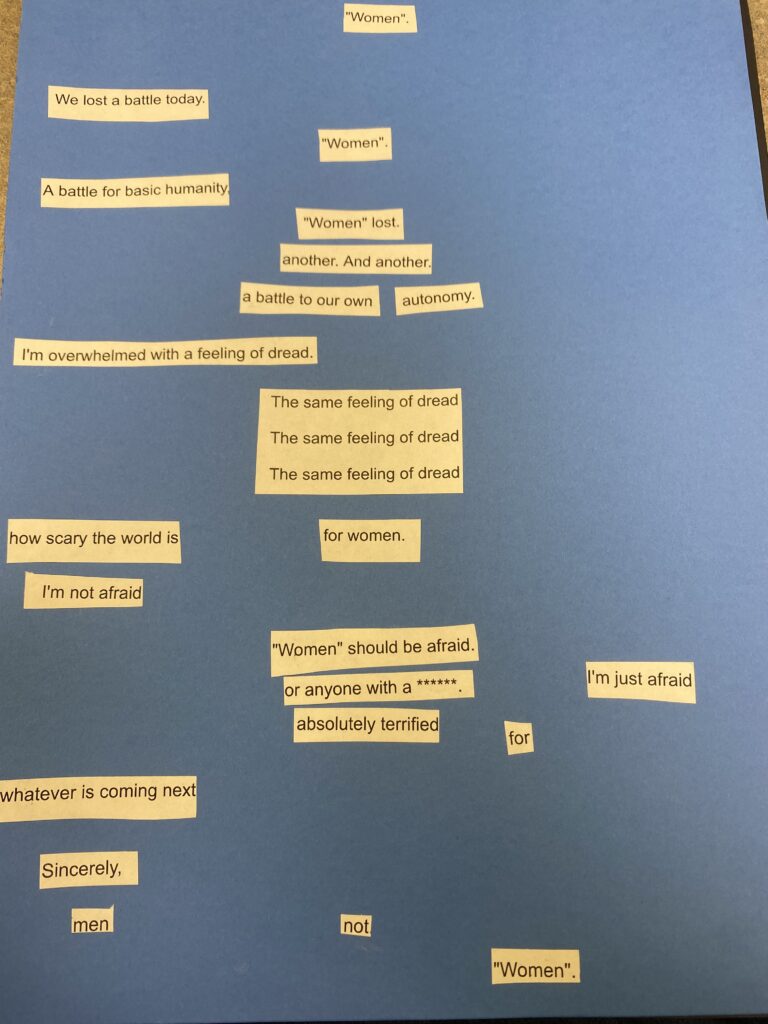
The title of my poem is “Women.” The one I found was written by someone named Elliot, and it was initially titled “Roe v Wade- And The World Caught Fire.” I found the original poem on a thread of many different poems about Roe v Wade being overturned. While reading through the lyrics, I looked for ones that expressed how outraged women were about this and phrases that seemed to be expressing how I felt too. After I chose the poem I was going to use, I just started cutting out words or phrases that caught my eye. When I started arranging them, I noticed that I could set up my poem to have two different perspectives; a man’s and a woman’s. As you read my poem, the first column of words is meant to be a man speaking, while the second column is a woman. When planning, I thought that the men’s perspective should come first and the women’s should sound like an echo or afterthought because that’s often how these decisions are made. We often find that men in powerful positions use their power to make poor, thoughtless decisions about topics that don’t involve them. So that is what I wanted my poem to express- men trying to make situations about themselves and getting involved in business that is not theirs. We have seen this happen countless times, but now this can be a life or death situation for women. A felony and two to twenty year prison sentence now follow the act of attempting to receive an abortion. Abortions are healthcare and now it is illegal for women to seek out that healthcare. So now what are women supposed to do? Do they try to receive an abortion for their ectopic pregnancy and face a felony or do they let themselves die? The law, created by men, says to let them die. 

White Man’s World

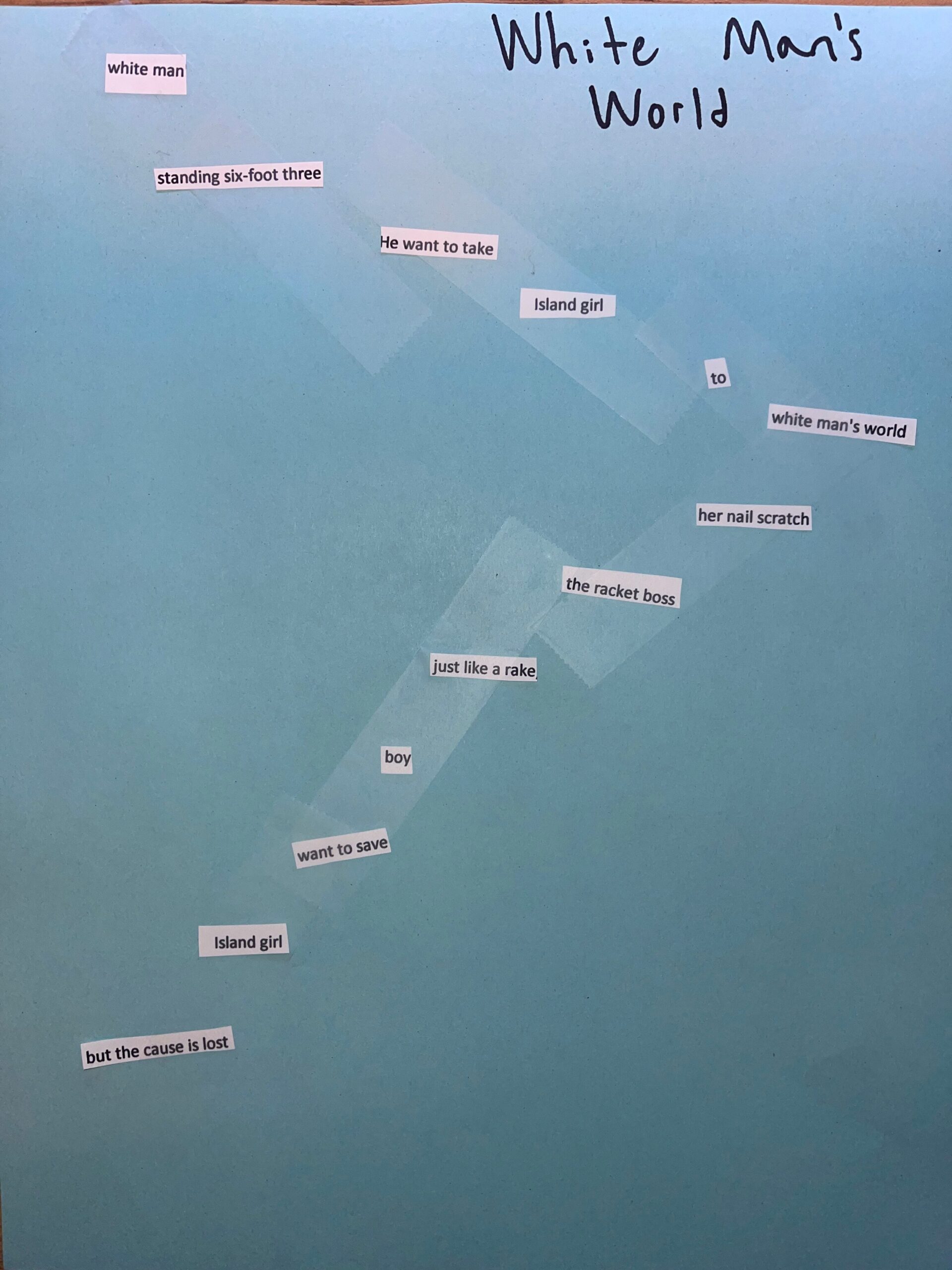
I used the song “Island Girl” by Elton John to create my found poem. The song “Island Girl” is very offensive and is no longer performed by Elton John as he got major back lash when he released it. The song is about white men taking advantage of a darker skinned girl and not treating her as an equal. The song has very racist and sexualized lyrics when describing the girl such as ” Well she’s black as coal, but she burn like a fire. And she wrap herself around you like a well-worn tire” (Elton John). It is obvious why Elton John received the negative response from his fans and listeners. His song is really upsetting not only for the hurtful lyrics that he chose to use but also that it can be related to many true events that take place. I used inspiration from the song to create my found poem showing how white men abuse their privileges and power. In my poem, it appears that a white man is attempting to take an island girl back to a “white man’s world” but she is fighting to not go. A boy tries to intervene but it is too late and the island girl is taken against her will. I wanted to create a poem that is impactful and brings awareness to the fact that white males tend to do what they want, especially against those with less rights.

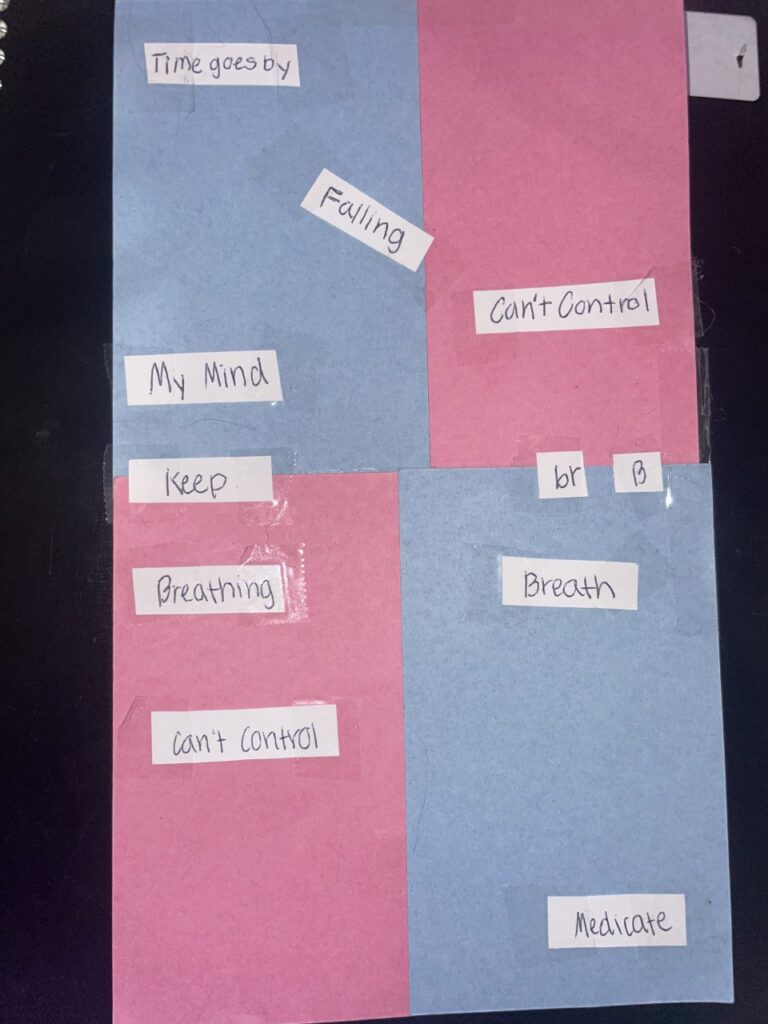
Breathin

This poem was created from the lyrics of the song “Breathin”, by popular singer Ariana Grande. The song is based on anxiety. Being in the public spotlight due to her fame, Ariana Grande must face high levels of pressure and anxiety on a daily basis. I personally resonate strongly with this song as It has been difficult for me to find strategies to manage my own anxiety.

I repurposed the song lyrics to express some of the feelings that anxiety can bring up. At some moments it feels as if you can’t catch a breath. Breathing is one of the most common ways that is used to try to take control of your mind when feeling anxious. The song also represents how being medicated is usually a quick fix when trying to seek medical help for anxiety but many of these medications that are commonly prescribed can have consequences. I personally resonated with this aspect of the song a lot because I have tried to focus on breathing to reset my nervous system while I’m  anxious.

The poem is meant to be hard to make sense of and understand. This is because just like the poem anxiety in itself can be very difficult to understand. Breathing is also a repeated word in my poem. It is seen to be broken up into letters as well as just the word “breathe”. This is to show how anxiety can feel as if you can’t breathe or can’t get a full complete breath. 

Extra Credit Talk with Barrett Bowlin

I found Barrett Bowlin’s talk very insightful and inspiring, it gave me a new perspective and a new outlook on literature and writing as a whole. I found it amazing how he intertwined science and fact with fiction and imagination in his work because those are two things are very contradictory and opposite but as he was reading his writing, I found his combination of the two fascinating and brilliant. I found the particular story he read that took place at Bartholamules hospital very interesting. Vance as a character is very complex and someone that everyone looks up to and wants to be around even though Vance is truly a condescending person. I specifically remember the part of the story that centered around the idea of the boy patient with the scars from being struck by lightning. Although this part may seem random and insignificant, I found it very heartful and deep-rooted especially when he describes the beautiful, speckled scar that the lightning has left on his chest; it makes me think of beauty in the madness and like finding light in the dark which was bittersweet. Bowlin kept stressing this idea that to be a good writer one must be an avid reader and without reading you cannot be a good writer because they go hand in hand. I also found it very interesting how he kept referring back to the cyst on one patient’s neck and although I am not sure what the deeper meaning of it was, I enjoyed pondering the idea of what it may symbolize. I found it so special and cool that he is able to include pieces of his old job and his love for science into his new life and his book writing and storytelling. The way that he is able to mend his research based scientific mind with also his creative love for imaginative storytelling and fiction is something I have never seen an author combine before in such a casual way. I was also very impressed when he discussed this idea that a lot of the times when he is working on a story, he puts it away and comes back to it when the time is right. I always thought that authors continuously write a book until they are done and don’t start other projects, but he changed my perspective and made me realize that it is okay to have unfinished projects and unfinished business and taking time to think and stay away from something can sometimes bring you more intellect and a new improved understanding rather than trying to force ideas and brilliance in a rush to succeed. Overall, I found this reading to be super inspiring and I am very glad that I went to it and experienced it. I think that his talk and his way of writing is something that I will be thinking about for a while, I also feel inspired because him becoming a writer was unplanned and not what he originally pictured for himself but along the way he ended up doing it and now he is able to incorporate every obsession and everything he loves into his writing and can combine his love for science, reading and writing all in one while interacting and inspiring others.

Barrett Bowlin

I thoroughly enjoyed the reading presented and facilitated by Barrett Bowlin. His book, Ghosts Caught on Film, was very clever from the segment he read to us. I also really like the fact that the book’s publication date was not even a year ago, it feels fresh and current. I was very inspired by the fact that he pulls so much inspiration from science. It is not like anything I have really read before and it’s interesting to see the way his mind works in regard to writing and his other passions. Like the last visiting author, Benjamin Garcia, there were similarities in relation to the scientific and medical themes. They both studied science and I find it very fascinating that his career turned around after he did so much schooling. Something he wrote that I will be sure to use in the future is creating character maps. I like how he said that he doesn’t always use every little detail but he crafts it to get a vibe and better understanding of the characters he is writing about. Additionally, I think it is very interesting to write characters in fiction that are based on real people you know, which he did with his wife. He put a very large spin on the character his wife inspired, but he just used her as the foundation of something deeper and complex. I would really like to try his method of writing by doing it in solitude with no one else and after consuming a fair amount of caffeine. I think it would increase my productivity. Last semester, I went to a reading by Gina Nutt and she said something very similar about writing about your obsessions. Bowlin said that having frustration or anger also helps since you have a lot of emotion within. Previously in my head science as an overarching theme felt very non-fiction, researched, and fact-based so I admire how he can use something that can be so rigid and make a fiction story from it. Something that struck me as surprising was the speed and intensity with which he read. It felt frantic and exciting which is most likely not the way I would’ve read it if I had the book in front of me. I think it shows the fast-paced career in medicine and helping people. He was also very expressive with his body language. He would often snap and move his hands around which gave the story animation and liveliness. Barrett Bowlin was open about his experiences prior to his life as a writer and I enjoy hearing the backstory of what the authors do before they start their work. His tiered organization with the categories of writing samples was something I want to try in the future. I like how he always strived for his work to be published but accepts and acknowledges that most of his work will just be kept hidden. The analogy of them being called “orphans” was just as creative as it was humorous, and it acts as a means for personification. All in all, I found his reading to be inspiring and I learned a lot about his writing process as well as his personal life.

css.php Skip to content