Left, me.

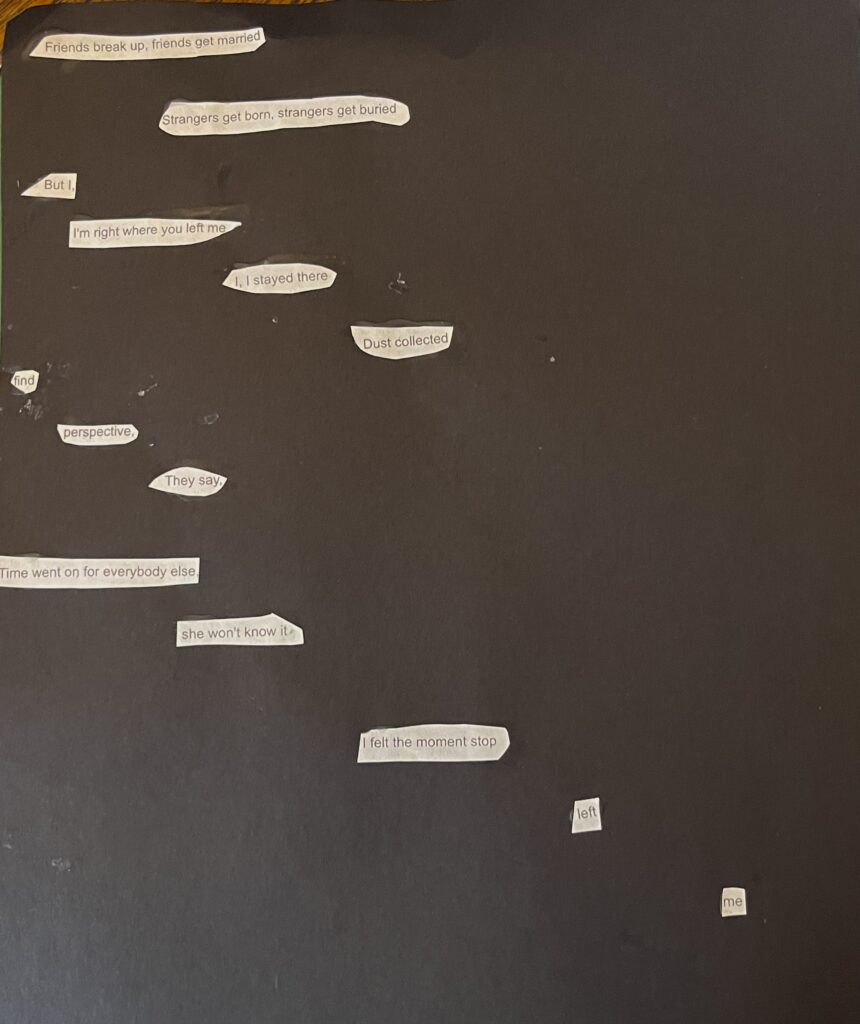
My found poem: ( picture will not upload)

Friends break up, friends get married.

Strangers get born, strangers get buried.

But I,

I’m right where you left me.

I, I stayed there

Dust collected.

Find

Perspective, 

They say,

Time went on for everybody else.

She won’t know it.

I felt the moment stop

Left,

me

I created my found poem through the use of lyrics from the song “ right where you left
me”, by singer and songwriter Taylor Swift. Taylor swift is known for her authentic, relatable, and artistically inclined song writing. The first time I listened to this piece of hers, it did not resonate with me. Then, years later I came across it again and it had transformed into a song that described my mental state due to the result of a hardship that impacted me significantly. A Lot of Taylors music is like this, it takes a few listens to intercept and make sense of what she is attempting to relay to her audience because her phasing is poetic in a sense. Creating this found poem revealed the the beauty of art to me. Its’ meaning can change depending on the situation or perspective in which it is experienced. The song is about being left by a loved one. She doesn’t specify whether it is a lover or friends but can fit into both of those categories. She uses metaphors such as, “ Friends breakup, friends get married. Strangers get born and strangers get buried”, to emphasize the idea that nothing is permanent. This song speaks to the difficulty and hurt of accepting this
concept that nothing lasts forever, really is. She wrote phases like, “ I am right where you left me” and “ Everyone moved on, I stayed there.” She is saying that in her subconscious she stayed in that relationship even though it had left her, she did not detach from it. This song is a bit depressing and dwells on being lonely and the victim. In creating a found poem with her lyrics from this song, I decided to create a positive twist to the story line. I pulled words and phrases that are relevant to the original piece and ended my found poem with, “ I felt the moment stop. Left. Me.” The direction I was going with this was the beauty of that moment when one finally lets go and psychology detaches from a period of their life that no longer serves them. She felt the moment stop, and then realizes all that is left is her or in the point of view the piece is written in, “me”. The moment in realizing that it is a positive thing that she is still standing and now can blossom into an even better version of
herself, my found poem is meant to embarrass loneliness and turn the mindset of being a victim to embracing self worth and freedom.
Original Piece:
“Right where you left me”
Song by Taylor Swift
Friends break up, friends get married
Strangers get born, strangers get buried
Trends change, rumors fly through new skies
But I’m right where you left me
Matches burn after the other
Pages turn and stick to each other
Wages earned and lessons learned
But I, I’m right where you left me
Help, I’m still at the restaurant
Still sitting in a corner I haunt
Cross-legged in the dim light
They say, “What a sad sight”
I, I swear you could hear a hair pin drop
Right when I felt the moment stop
Glass shattered on the white cloth
Everybody moved on
I, I stayed there
Dust collected on my pinned-up hair
They expected me to find somewhere
Some perspective, but I sat and stared
Right where you left me
You left me no, oh, you left me no
You left me no choice but to stay here forever
You left me, you left me no, oh, you left me no
You left me no choice but to stay here forever
Did you ever hear about the girl who got frozen?
Time went on for everybody else, she won’t know it
She’s still 23 inside her fantasy
How it was supposed to be
Did you hear about the girl who lives in delusion?
Break-ups happen every day, you don’t have to lose it
She’s still 23 inside her fantasy
And you’re sitting in front of me
At the restaurant, when I was still the one you want
Cross-legged in the dim light, everything was just right
I, I could feel the mascara run
You told me that you met someone
Glass shattered on the white cloth
Everybody moved on
Help, I’m still at the restaurant
Still sitting in a corner I haunt
Cross-legged in the dim light
They say, “What a sad sight”
I, I stayed there
Dust collected on my pinned-up hair
I’m sure that you got a wife out there
Kids and Christmas, but I’m unaware
‘Cause I’m right where
I cause no harm, mind my business
If our love died young, I can’t bear witness
And it’s been so long
But if you ever think you got it wrong
I’m right where you left me
You left me no, oh, you left me no
You left me no choice but to stay here forever
You left me
You left me no, oh, you left me no
You left me no choice but to stay here forever
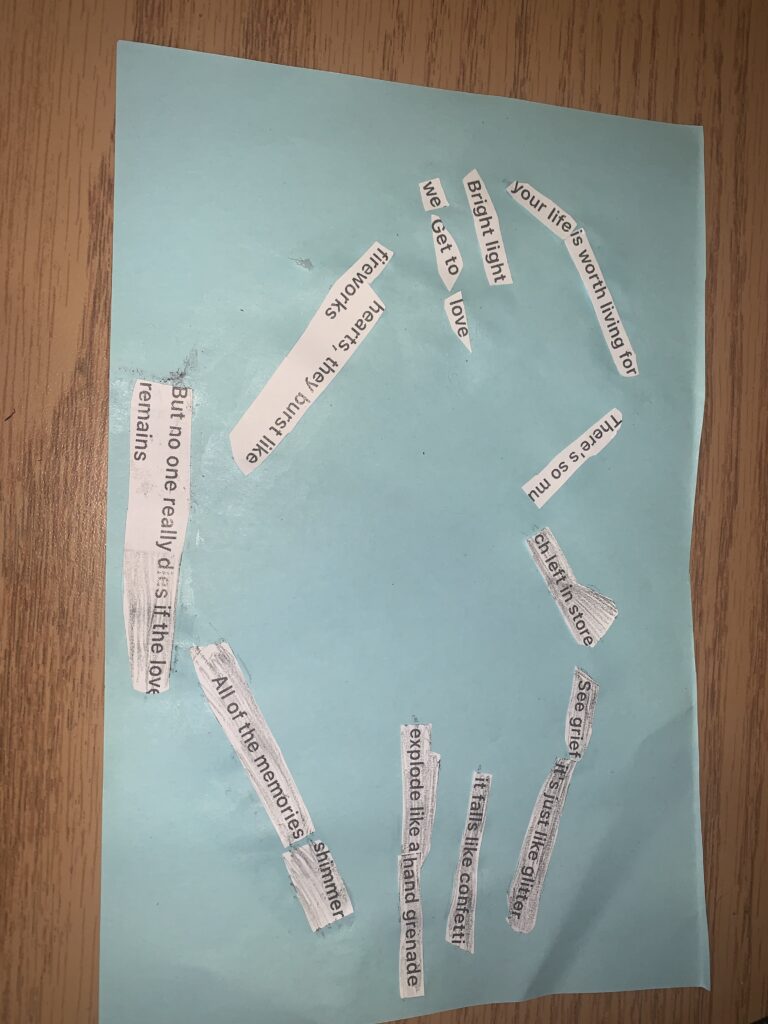
I named my poem “The Love in Greif”. I chose to use the song “Glitter” by Patrick Droney. I chose this song because it was used to represent my best friend at her funeral who passed last year. This song represents the good and the bad in grieving. I chose to use it because I knew I could make something beautiful and full of contrast.


The method I used to create this poem was to try and place the words in the shape of a heart. I also chose one side of the heart to be the positive side of loving people and the other side to be the darker side. I made it clear which side was which by shading the darker side. At the bottom of the heart is a really good quote which is “but no one really dies if the love remains” I really love this quote because it is true people keep living in your memories and in your hearts till the end of time. Making this poem really touched me because it was inspired by my friend Carli.

The Dehumanization of Africans, Told Through Gregson v. Gilbert in Zong!

Zong! is a found poem, created entirely out of a court case known as Gregson v. Gilbert. As we know, found poetry is created by taking the existing versions of text and rearranging, reframing, and cutting out words to form a new, poetic meaning. In this case, M. NourbeSe Phillip uses this court case as the basis for Zong! because the Africans being fought for in the case were viewed entirely as commodity, not as human.

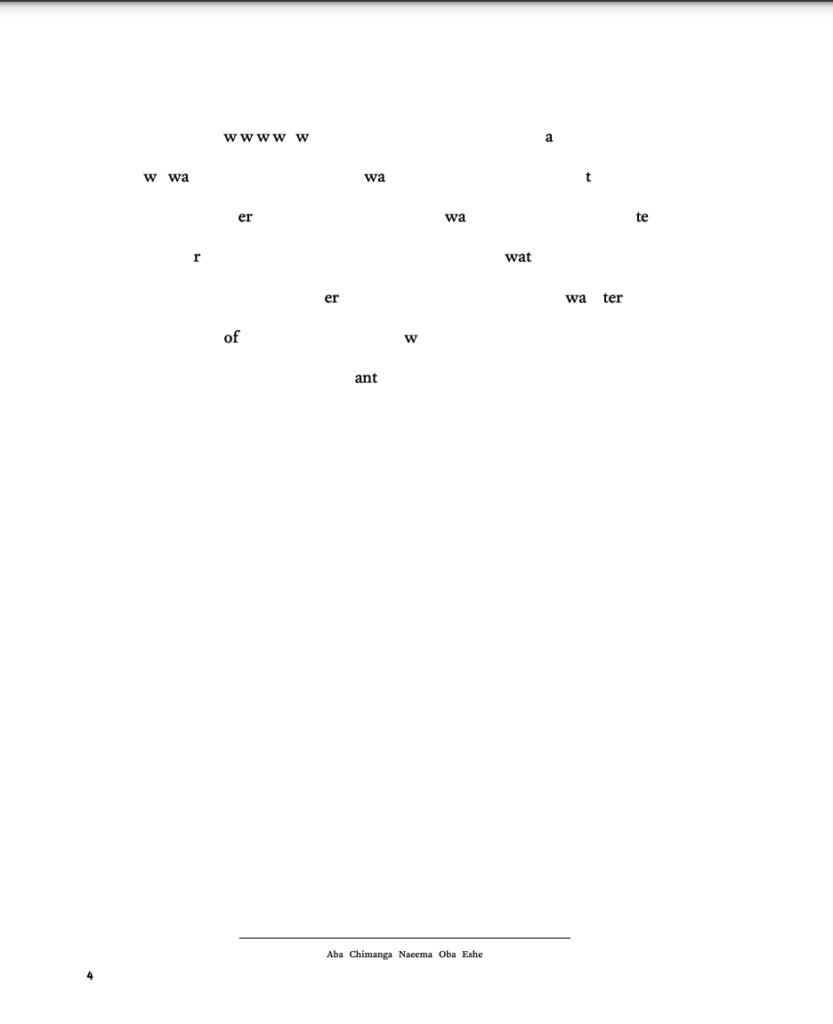
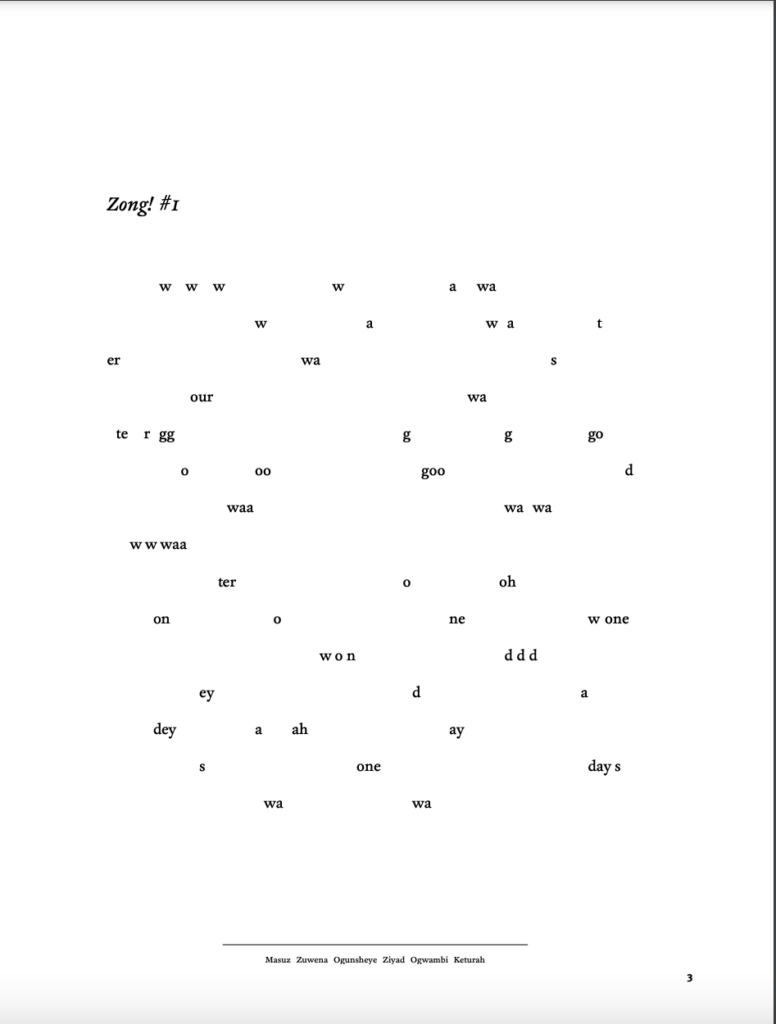
I’d like to draw attention to the first couple of pages of the chapter.

Did you all read these lines aloud when you were reading the book? How did it sound? Very faint, out of breath perhaps. You can see that words are almost formed and never spoken in full. Cut off constantly, never able to actually speak or form anything for us to hold onto. These pages are meant to simulate the sounds of drowning, using only the spliced words and repeated sounds of the court case. These morbid pages are included to demonstrate the true monstrosity of this massacre, making the reader understand that the Africans had no say in their fate this for day.

Phillip uses the court case to highlight many factors of this journey, including weather, time frame, and the Africans on board themselves. Phillip tells, “. . . of sea and perils of water (one day) water— day one . . . of months . . . of weeks . . . of days . . .of sustenance lying dead” (9.) Sustenance is referring to the slaves onboard, as they are lying dead after days and weeks at sea, facing what the court case calls the perils of water. Sustenance specifically means a food or drink capable of replenishing strength. I think using this word as she does is significant because she is framing the Africans as cargo, but she is able to highlight the value of the person themselves. The emphasis on timing also draws the reader in on the horror of the situation. They were on the sea for months! They had no comfortable food source and were being treated quite literally as insurance money, despite being in unthinkable situations suffering; women, children, families.

Disregarding human life as this is disgusting and unthinkable, which is why I think it is significant that it is written out of the court case. As Phillip says, “The conversion of human into chattel becomes an act of transubstantiation the equal of the metamorphosis of the eucharistic bread and wine into the body and blood of Christ. Like a magic wand the law erases all ties — linguistic, societal, cultural, familial, parental, and spiritual;” (196) By taking away their identity as African people, reducing them to slaves/chattel, they’ve had their stories hijacked. Reducing them to nothing but objects, despite the fact that they have diverse lives, cultures, and value on their own. These were stories which deserved to be heard and lived. They were not commodities, they were people. “Without life in life —with a story that cannot but must be told” (196.)

Discussion Questions

  1. What did you guys think of the first couple of pages? Did you read them aloud as well? What did you think was happening/trying to be shown?
  2. Do you think the way this book is told changes your interpretation? Are you truly capable of getting their stories when its’s told this way? Was this vagueness intentional?

Works Cited

Philip, M. NourbeSe. Zong! Wesleyan University Press, 2008.

The Significance of Philip’s Textual Format Throughout Her Poetry in Zong!

M. NourbeSe Philip’s book, ‘Zong!’, Includes works of found poetry symbolizing the destruction of slaves lives through the unfathomably vague text. Philip leaves the reader with no context of the events occurring. This unknowingness represents the lack of knowledge of one being thrown into slavery, experiencing horrific things with little to no understanding of their experiences. The simplicity and vagueness throughout the poems often dismiss the magnitude of the lives lost and the merciless acts against them. This symbolizes the dehumanization of African Americans across generations. Buried away by a corrupt system, over one-hundred forty slaves were thrown overboard. A Massacre somehow justified that has been overlooked and hidden in American history.

Gregson V. Gilbert, also known as “The Zong Case”, was the document that Philip picked apart to form the poems we see throughout the book. “I mutilate the text as the fabric of African life and the lives of these men, women and children were mutilated”(p.193). The broken wording and incomprehensive format of the text gives the readers a sense that the poems are not complete, as if they are missing something. The formatting demonstrates that the text has been manipulated or destroyed as if it held no meaning to begin with. This mirrors the deaths of many that were stripped of their identity, unable to be remembered. “The African men, women, and children on board the Zong were stripped of all specificity, including their names. Their financial value, however, was recorded and preserved for insurance purposes, each being valued at 30 pounds sterling” (p.194). 

The randomization and disorganization in the structure of the poems can be viewed as a representation of the random picking of African slaves. The owners wanted slaves to work with each other assuming this is because it seemed to be more meaningful and productive. Philip makes the correlation in her poetry. “My urge to make sense must be resisted” (p.193). She expresses that grammar is the “force” that makes her words work together, without grammar they don’t.

Discussion Questions

  1. In what way(s) did you find the organization and randomized structure of the text significant?
  2. Philip’s emphasizes the need to fight the urge to “make sense”. Do you agree with this mechanism in her poetry and its textual motives?

Citation

Philip, M. NourbeSe. Zong! Wesleyan University Press, 2008.

The significance of sense of self in page 136 to the end of Citizen: An American Lyric by Claudia Rankine

Throughout all of Citizen: An American Lyric by Claudia Rankine we see Rankine struggle with identity. In the last section, we see her gain more of a sense of self. Rankine’s sense of self involves everything she is including her hardships, identity, and personality. There are a few places we see Rankine talk about these. 

In the last chapter, Rankine starts by talking about this ache. “Some years there exists a wanting to escape—- you, floating above your certain ache—– still the ache coexists.”( Rankine 139) Rankine talks about this ache that people live with. This ache that no matter what will always be with you. The wording of “you, floating above your certain ache”(Rankine 139) makes abundantly clear that not only does everyone have an ache but that the ache is beneath you. The use of the word you in this quote also makes this ache more personal. Her goal was to have her readers think of the ache that coexists with themselves and understand the feeling she is talking about. Rankine wants people to understand that this ache is a part of you when she says that the ache coexists. Rankine does a very good job connecting the sense of self with racism in this last chapter. Rankine shows how the sense of self is understanding that you are different and accepting it on page 148. “you laugh and ask what else her privilege gets her? Oh, my perfect life, she answers.”(Rankine 148) This quote shows how it is understood that there is a difference and that this difference is the ache but the ache is beneath you and not worth the worry because it makes you who you are. 

In the section labeled July 13, 2013, the ache that Rankine talks about is shown during the event of Trayvon Martins’s killer being acquitted. “The outside blistered the inside of you, words outmaneuvered years.”(Rankine 156)  Rankine talks about how the ache is this blistering that is happening inside of you. She says how words are outmaneuvering the years and this means the words people are saying are killing you faster than the years that go by. This is important because when talking about a sense of self you think of finding inner peace and loving who you are but this chapter has proved many times that sense of self is being okay with the ache and understanding that you are better than it. In this chapter, we see one man making racist remarks while listening to the broadcast of Trayvon Martins’s killer being acquitted. The friend jumps out of the car to say something to this man but is immediately ushered back to the car because the protagonist knows that this situation can cause serious harm to themselves. This once again shows the ache always has a place in someone’s head. This ache causes the protagonist to try and isolate themselves from their feelings so they don’t cause any scenes or harm. 

In my opinion, this section had hard and easy spots to read. Rankine clearly stated about this ache but made us dig through short broken-up sentences to see the connection of ones race being their ache. I love Rankine’s writing style although it is different and sometimes difficult it holds raw emotion and relatable wording. The approach of using raw emotion and relatable wording brought more of an impact on this ache and how people deal with it. 

Citations:

Rankine, Claudia. Citizen: An American Lyric. Graywolf Press, 2014. 

Discussion Questions:

Looking back at the whole book do you see this ache come up intentionally? 

Did the word “you” make this ache have a greater impact on you? If so can you relate to everything Rankine was saying? 

The emphasis of Individualism throughout pages 56-91 of Citizen: An American Lyric by Claudia Rankine

Throughout the beginning half of this section, (p.56-60 ) of this section of Citizen: An American Lyric by Claudia Rankine, I noticed an emphasis on how individualism can be utilized in coping with micro aggression. According to the Oxford Dictionary, Individualism is defined as, “ the habit or principle of being independent and self-reliant.” Rankine was broad and general in her wording, so that the reader can apply these phrases in cases of micro aggression or in general life scenarios in regards to dealing with people. Rankine is pushing the idea that we are all individuals with our own visions and aspirations in life, a quote from page 57 reads, “The destination is illusory. You raise your lids. No one else is seeking.”  The way in which I interpreted this is that no one else is paying any mind to your final destination, that is simply between yourself and obstacles within the universe. When we are focused on our own path, others actions should not have a strong impact on our well being. On page 60,  Rankine writes, ​​”If you let in the excess emotion you will recall the Atlantic Ocean breaking on our heads.”  This indicates that letting outside words and opinions of others (possibly micro aggression) ignite excessive emotions within you, that it will be damaging. I interpreted this section of literature as emphasizing the importance of understanding that no one is thinking about your insecurities and issues except for yourself, and that our thoughts are our own demons at times. If we internalize others’ actions, it will be very difficult to achieve happiness. The security of self in absence of others’ energy is necessary so that when microaggression occurs, one is able to cope with it and move onward without an emotional setback. Another outlook that Rankine shared was how one’s relationship with the past, “The past is a life sentence, a blunt instrument aimed at tomorrow (59).” Claiming the past is significant and a roadmap for the future of your life. This is a different take to this concept as we often hear people say let go of the past it is over and done with. Rankine is saying to use the past as a road map for your future. This section contained a lot of insightful phrases that I read as advice or a guide to emotionally get through microaggression as well as life in general.

A literary strategy that occurs throughout the piece is contradictory statements. I believe Rankine incorporated opposite ideas within singular sentences in attempts to have the reader form their own opinion on the specific situation. For example, when describing a scenario that takes place in the gym, page 65 read,  “ you do go to the gym and run in place, an entire hour running, just you and your body running off each undesired desired encounter.” The use of the words “undesired ” and”desired ” are placed next to each other which initially confused me and being completely honest still does confuse me. I think this technique brings attention to contradictory thoughts we have in our minds, sometimes we want things and later regret actions taken due to those desires. When referring to cases of microaggression, Rankine says, “Each time it begins in the same way, it doesn’t begin the same way, each time it begins it’s the same. (89)” This quote led me to believe that different perspectives are being displayed in regards to incidences of microaggression. Some believe that every time it begins the same but others may believe that each case is unique and starts off differently. On page 84 a scenario of highschool boys getting into a physical altercation over what I assume is race due to the context of the book. The following page, (85) opens with, “Boys will be boys being boys feeling their capacity heaving butting heads righting their wrongs in the violence…..” This relates to the idea of individualism as a horrific incident including violence and fist punching but Rankine takes the casual approach when reflecting on the situation by saying boys will be boys. This can apply to people. people will be people, harse and many times unforgiving but we shall move forward with confidence in our own strong being. 

This section of literature was intense and a lot to digest in my opinion in regards to navigating through complex worded sentences that contradict each other at times. I found Rankines writing style interesting in that this section took a more of an  advisory approach compared to the rest of the reading so far. Advice was given through complex phrases that were written for interpretation while educating the reader about microaggression as well. This approach brought awareness to microaggression while shedding light on the significance of being secure as an individual rather than giving outside elements the power to alter our well being.

Citations

Rankine, Claudia. Citizen: An American Lyric. Graywolf Press, 2014. 

Oxford Learner’s dictionaries: 

https://www.oxfordlearnersdictionaries.com/us/

Discussion Questions:

  1. Did you interpret the section discussed as advise regarding the significance of individualism as well?
  1. How do you understand the Rankines contradictory words being places next to each other within sentences?

Rankine’s Struggle with Identity

In chapters 4,5, and 6 of Citizen: An American Lyric written by Claude Rankin, we can clearly see the character go through hardship in her everyday life. Rankine connects the world to her emotions and what she does, the world responds. The character is struggling with an identity problem, and she is trying to find who she is and discusses this blue light in yourself where she is trying to find ways to cope with the racism that get presented later in the reading. 

In the first chapter of the reading, the narrator talks about “the sigh” and how she keeps sighing, but the world keeps telling her to stop. The narrator brought up memories, and painful ones at that and how it produces headaches, and you seem to wonder why is it so important to remember memories? “You like to think memory goes back though remembering was never recommended. Forget all that, the world says; Feelings are what create a person, something unwilling, something wild vandalizing whatever the skull holds” (Rankine 61). Rankine discusses why people try to forget memories because you should focus not on the past but the present and future. But as Rankine discusses, why would you want to forget your memories that make you who you are. Then later in the chapter we see the underlying racism appear when the narrator tells the story of where the tennis player is upset with the official during the match and the player is just told to “Feel better. Move Forward. Let it go” that is formally told to Black people and told to them especially about the past and the painful memories of racism. 

In this chapter we see the identity problem come out. Rankine talks about your hands and your eyes and the different ways of expressing yourself but despite that she still talks about disguising and staying in the back not having an outburst. As I read on in the chapter, I thought more and more about this blue light that she talks about. When does it come around and do you take advantage of when it comes and have the outburst that Rankine discusses. Like the early chapter where Rankine talks about the use of “you”, she now talks about “I” and why that is significant. “I has so much power; it’s insane” and “Tried Rhyme, Tried Truth, tried epistolary untruth, tried and tried” (Rankine 71). The narrator talks about how “I” is very important and how it can be a strength but the contradicts it when she says later down how she tried but people know that she suffers, and they see that through the expressions brought up earlier in the chapter. What is the difference between “You” and “I” and why are both so significant in the reading.  

In chapter 6, Rankine discusses two very important events in Hurricane Katrina August 29, 2005, and the story of Trayvon Martin February 26, 2012. During Hurricane Katrina we see racism occur when they discuss where the rescuers are. “Where were they? Where was anyone? This is a goddamn emergency” and “It was the classic binary between the rich and the poor. Between the haves and the have-nots, between the whites and the blacks” (Rankine 83) I tend to wonder what and why there is hesitancy when it came to a serious event such as Hurricane Katrina. Rankine discusses how people didn’t want to go there to help and that “FEMA said it wasn’t safe to be there” (Rankine 84) but I believe there is more to that. How were the rich able to be rescued safely, how were the whites able to be rescued safely? There is a lot of underlying racism presented that I was unaware off that Rankine shows us. After she discussed Hurricane Katrina, Rankine decided to tell the story of Trayvon Martin. Rankine starts off saying how “My brothers are notorious” (Rankine 89) and that they didn’t go to jail and were good. Rankine repeats that and I wonder what makes that so important. The tone changes quickly, when they say how “The hearts of my brothers are broken. If I knew another way to be” (Rankine 89). Trayvon Martin was killed on February 26, 2012. He was killed for no reason having no weapon or anything was shot and killed in cold blood by George Zimmerman. At the end of the chapter on page 90 we see a photo that looks disturbing as there is one man looking at the camera and pointing to a tree. The photo was called “Public Lynching” where they hung a black man. There is a connection between this photo and the Trayvon Martin story and that was they were killed for an unjust and racially motivated reason.  

Overall, these 3 chapters of Citizen: An American Lyric helps create another viewpoint on microaggressions and underlying racism that forces people like the narrator into an identity conflict. Claudia Rankine continues to give us valuable insight on the problem at hand and will provide more and more details as the Book goes on. 

Discussion Questions 

  1. What does the word “I” change about the feeling from when you’re called “you”? What similarities and differences are there? 
  1. Why was the event of Hurricane Katrina and Trayvon Martin’s death so important to the chapters and book about racism and microaggressions?  

Citations 

Rankine, Claudia. Citizen: An American Lyric. Graywolf Press, 2014.   

Microaggression Expressed Through Poetry

Citizen: An American Lyric written by Claudia Rankine is a large work of poetry that explores the racism and injustice that many people of color have experienced in their lifetime through microaggression. Microaggression by Webster definition is “a comment or action that subtly and often unconsciously or unintentionally expresses a prejudiced attitude toward a member of a marginalized group (such as a racial minority)” (Merriam-Webster). These microaggressions are much harder to detect than straight forward acts of racism but Rankine does and excellent job showing us different situations in which they have occurred. Rankine also strategically uses the word you in this chapter to better connect the reader to the story. This first untitled chapter gives us a detailed look into what we can expect throughout the rest of the book. 

In the first untitled chapter of this book, we notice right away in the opening sentence Rankine’s usage of second person point of view as she continually uses the word “you” to refer to the reader. “When you are alone and too tired even to turn on any of your devices, you let yourself linger in a past stacked among your pillows” (Rankine 5). This view now implies that us as the readers are a part of this story being told. Rankine has intelligently used this word in order to immerse the reader into the story and allow them to better picture and understand the details of what is happening in every situation. We as readers do this by putting ourselves into the shoes of whomever is experiencing these forms of discrimination. The usage of second person helps to open our eyes and break us out of the bubbles we live in as we see how other people in America are treated. 

Throughout the chapter Rankine presents mini stories of which people, we don’t know who exactly as she has now made these stories ours, have experienced microaggression. We can see it at the start that we the readers are experiencing a situation in which a friend has called us by the name of her black housekeeper not even thinking twice about it, “You assumed you two were the only black people in her life” (Rankine 7). This expresses a form of microaggression as it is explained that this “friend” has unconsciously slipped up and when distracted has called the reader by some other person of colors name showing that she has not interacted with many people of color. And at the end of the chapter we are told that we are headed to visit a therapist that specializes in trauma counseling, “Get away from my house, what are you doing in my yard?… You have an appointment? She spits back. Then she pauses. Everything pauses. Oh, she says, followed by, oh, yes, that’s right. I am sorry” (Rankine 18).  This quote shows us that this therapist has assumed the reader was there to cause trouble when in fact they were there for a scheduled appointment. We can assume that because us the readers have only spoken to them over the phone, they assumed we were of a different race. 

While reading this chapter we can at a glance see that all of these experiences seemed to be simple misunderstanding or unconscious mistakes but as we look at the chapter as a whole, we see the bigger picture of these interactions and understand that America is full of them. Rankine has helped us to understand that all of these “unconscious” or “unintentional” actions are really just conscious thoughts that live in the heads of many Americans. No one is innocent from these conscious biases or thoughts even if you are not the one experiencing or provoking as we repeatedly hear and talk about racial discrimination, whether it be a discussion in a class or something you have directly heard or witnessed yourself, these biases live in everyone. 

Overall, this first chapter of Citizen: An American Lyric was extremely thought provoking and helped open my eyes and immerse us into the experiences the author Claudia Rankine’s has told of racial discrimination through microaggression as well as help us get a better insight as to what is to come in the future of this book.  

Discussion Questions

  1. How did Rankine’s usage of the word “you” make you as a reader feel? How did you interpret her usage of the word? How did it affect the way you read the chapter? 
  2. There were a couple of visual pictures presented in this chapter, one on page 6 and one on the final page 19. How did you interpret these images? How did they affect your reading of the chapter? 

Citation

Rankine, Claudia. Citizen: An American Lyric. Graywolf Press, 2014. 

Microaggressions: “Domestic Tragedy”

Claudia Rankine’s Citizen: An American Lyric describes distinguishing events that many people of color experience throughout their lifetimes that imprint lasting impressions. Derald Wing Sue’s article “Microaggression’s: More Than Just Race” further explains the idea of microaggressions displayed in the chapter with an in-depth synopsis of conscience thought. Here, many situations are posed which are far too similar for many of those that do not fit into the white-male unsaid criteria. In her work, Rankine publishes thought provoking experiences of microaggressions through the eyes of said individuals that leaves all to consider how deep actions plunge into shame and inquisition.  

In Rankine’s first untitled chapter, a series of short poetic essays share stories of inherent racism in everyday life as the story narrated can truly be anyone’s story. The portrayal of a racist America does not seem so far out of reach when discussed aloud with microaggressions being the center of it all. Microaggressions are unintentional actions “that communicate hostile messages to marginalized people” (Wing). The introduction of the reading is truly striking as it connotates that all people share similar experiences and from afar we all have the same ending as she tells with the shared experience of falling asleep. This however is just the beginning as the stories begin in an almost shocking way to incite the audience of the bittersweet experiences of people of color. 

 We observe vast experiences of microaggressions through gratitude, caution and disdain that prove that the attempt for equality has not gone far enough as our conscious thought wraps itself in such a way that humans are not as moral as we think. Although it is not the most extreme example of racism through microaggressions told, Rankine incites a truly disheartening experience as she shares an experience where an unknown man discusses how he must “hire a person of color when there are so many great writers out there” (Rankine 10). Here the microaggression suggests that being a great writer has a direct correlation to race whereas ability has no color. Soon she feels disgust for the person and even questions her sense of humanity herself as a domestic tragedy although this is not the case. Further capitalizing on the words “so” and “great” that Rankine inserts here, it signifies the assumed inability of people of color. As the word “so” promotes a heavy exaggeration of his thought and the idea that opportunity should arrive to white people while “great” here gives the impression that people of color cannot reach the potential to be “great” and are not so due to their race, we understand the impact of the statement. However, another idea is the assumed mutual understanding that this man is white which in turn provokes the audience to understand their own “inherited racial biases that exist outside their conscious awareness” (Wing). Without having to explain, Claudia Rankine has further suggested that we are not as indifferent as we previously may have thought. Although they do not consume us, we do hold these biases within ourselves as many of us have heard or been the perpetrator of this untaxed offense. 

I realized that I do hold these biases through her tales as hard as it is to accept. It became most telling for me as I pictured the scene in my head and assumed which group each belonged to as well as how I assumed the man had phrased it incorrectly. However, this is incorrect as he said it exactly how it was meant: with the idea of diminishing a group. The definition of microaggression describes an unintentional manner but the truth is that it carries intention and comes within us. From certain expressions or phrases, microaggression comes in many forms such as phrases, glares or the manner we consider our safety in certain situations. 

In conclusion, Claudia Rankine’s poetic tales of microaggressions depict the fault within ourselves where conscious thought has the potential to be hurtful. Here, we must consider how we carry ourselves and observe our inner monologue. The chapter is truly thought provoking as Rankine’s terminology annunciates the impact microaggressions leave and how they may look like.  

Discussion Questions: 

  1. Through the chapter, Claudia Rankine highlights stories with the shared concept of microaggression. How do you believe she tried to invoke a reaction from the audience? Did she? 
  1. On page 12, Rankine shares an experience of microaggression through nonverbal action as well. What is the depth of this action? How are nonverbal microaggressions presented? Why did the woman move closer to her? 

Rankine, Claudia. Citizen: An American Lyric. Dramatists Play Service Inc., 2018.  

Wing Sue, Derald. “Microaggressions: More than Just Race.” Psychology Today, Sussex Publishers, 17 Nov. 2010, https://www.psychologytoday.com/us/blog/microaggressions-in-everyday-life/201011/microaggressions-more-just-race. 

Life “At The Western Palace”

While reading the chapter “At The Western Palace” in Maxine Hong Kingston’s book The Woman Warrior, it became clear that it differs from the other chapters. What makes this chapter different from others is the fact that the narrator, Kingston, doesn’t show up as often, however, we are introduced to Brave Orchid, her mother and we learn about Moon Orchid, her Aunt, and her story. This chapter recounts the story of her Aunt’s life in America, she moves to the United States from Hong Kong after thirty years and we learn all about what she experiences.

One of the key themes of “At The Western Palace”, was the difference between old Chinese culture and the culture in America. At the beginning of the chapter we are introduced to Brave Orchid’s children, throughout the chapter we can see the difference between Brave and Moon Orchid’s standards of traditional Chinese and Brave’s children’s lack thereof. Moon Orchid comes to America with gifts to give to her family from China, she first gave them shoes, which Brave Orchid’s children then spoke about to one another in English, saying “She must give us the leftovers”(119), their mother, Brave then “glared sideways at her children”(120) to send them the message that they are lacking manners. The next thing she gave the children were paper dolls, the children went on to play with them, Kingston says “How greedy to play with presents in front of the giver. How impolite (“untraditional” in Chinese) her children were” (121), her children didn’t follow any of the traditional Chinese culture or manners. 

This chapter also explores the immigrant experience of Chinese women in America, Kingston’s Aunt, like many Chinese women at the time, was sent to work in America as a young girl, without her consent or understanding of the life that awaited her. The chapter vividly portrays the harsh realities of life for many Chinese immigrants in America, who faced poverty, discrimination, and exploitation. Kingston describes the cramped and rundown tenements where many Chinese immigrants lived, in stark contrast to the luxurious surroundings of the Western Palace where her aunt worked. Kingston also highlights the strength required to survive, despite the abuse and mistreatment Moon had endured, she persevered, and she was able to find beauty and meaning in the midst of such hardship, this is an example of just how strong of a person Moon truly was. At the same time, however, the chapter also highlights the ongoing impact of the abuse and trauma experienced by Kingston’s Aunt, she begins to become paranoid, and eventually Brave received a letter from her niece about Moon that says, “she had overheard Mexican ghosts plotting on her life. She had been creeping along baseboards and peeping out the windows” (155). This shows how much the American lifestyle has broken Moon down as a person and how much trauma it truly caused. 

Overall, “At The Western Palace” is a thought-provoking chapter that shows us the difference between Brave and Moon Orchids’ belief that traditions should still be followed and how Brave’s children are Americanized, whereas they follow American traditions rather than Chinese. Throughout the story of Moon, Kingston illuminates the harsh realities faced by Chinese immigrants in early 20th century America and highlights the resilience and strength required to survive in such challenging circumstances.

Discussion Questions

  1. Do you think the difference between Brave and Moon Orchid’s choice to follow traditional Chinese standards makes it hard for them to build relationships with other family members? 
  2. What do you think Kingston is trying to say about the lasting impact of trauma and abuse on individuals and communities?

Citation

Kingston, Maxine Hong. “At The Western Palace”, The Woman Warrior

css.php Skip to content